Showing posts with label Graphic Novel. Show all posts

Tuesday, August 2, 2016

American Born Chinese

https://images-na.ssl-images-amazon.com/images/I/51zCS5BMbyL._SY344_BO1,204,203,200_.jpg


Bibliographic data:  


Yang, Gene Luen (2006).  American Born Chinese.  New York: Square Fish.

Summary


Three stories are told, each focusing on a character searching to be accepted.  An ancient Monkey King wishes to be accepted as a God, but heaven doesn’t have a place for monkeys.  A young first-generation Chinese American boy doesn’t want to have anything to do with his new straight-off-the-boat Taiwanese classmate.  All-American Danny is embarrassed by his Chinese cousin Chin-Kee…again.  Will any of them find their place in the world?

Analysis


The three unique stories in American Born Chinese take turns being told, keeping the reader questioning how they are related and wondering what will happen to each of the characters.  At first, it is unsettling and awkward to change between the different story lines, however the graphics tie the stories together and provide a sense of continuality.  

The individual stories are interesting in their variety.  The story of Jin is very realistic.  Danny’s story is realistic, except that his Chinese cousin Chin-Kee exaggerates every Chinese stereotype, from foot binding to mispronunciation of the L and R sounds in words.  The Monkey King is a mythological story, with immortal gods and talking animals.  These different story types provide something to interest any reader.

Young readers who are from multiple backgrounds will easily relate to the stories in American Born Chinese, however most young readers would appreciate the struggles of the characters to fit in.  The ultra-stereotypical portrayal of Chin-Kee will likely be uncomfortable for many readers, however is beneficial for examining stereotypes and helping to show the reader the importance of kindness and acceptance. 


Activity:


The focus of American Born Chinese is accepting and appreciating one’s cultural heritage.  In this case, the book speaks to those with Chinese heritage.  To add to this understanding, readers could research famous Chinese people or Chinese-Americans.  This list from biography.com could be used as a starting point for research. 

Biography. (2016) Famous Chinese Americans. Retrieved from http://www.biography.com/people/groups/chinese-americans (accessed July 31, 2016)


Related Resources:


Many teachers are reluctant to utilize graphic novels in the classroom, despite the high interest that many student show.  After reading a graphic novel and addressing curriculum topics, such as reading pictures, making inferences and dialog, students can then use these skills and strategies to create their own graphic novel.  The following teacher’s guide would assist in preparing lessons for older students to create unique novels.

Slate, Barbra. (2010)  YOU Can Do a Graphic Novel.  Retrieved from http://www.penguin.com/static/pdf/teachersguides/you_can_do_a_graphic_novel_TG.pdf (accessed July 31, 2016)

For younger readers or students who need more structure when preparing their writing, Scholastic has a comic builder based off some of their graphic novel series.  If students are at a loss for what to create, they can utilize the pre-drawn scenery and characters to create their own story.

Scholastic Inc. (2012)  Graphix: Comic Builder.  Retrieved from http://www.scholastic.com/graphix/createcomic.htm (accessed July 31, 2016)


Published Review:


“With vibrant colors and visual panache, indie writer-illustrator Yang (Rosary Comic Book ) focuses on three characters in tales that touch on facets of Chinese American life. Jin is a boy faced with the casual racism of fellow students and the pressure of his crush on a Caucasian girl; the Monkey King, a character from Chinese folklore, has attained great power but feels he is being held back because of what the gods perceive as his lowly status; and Danny, a popular high-school student, suffers through an annual visit from his cousin Chin-Kee, a walking, talking compendium of exaggerated Chinese stereotypes. Each of the characters is flawed but familiar, and, in a clever postmodern twist, all share a deep, unforeseen connection. Yang helps the humor shine by using his art to exaggerate or contradict the words, creating a synthesis that marks an accomplished graphic storyteller. The stories have a simple, engaging sweep to them, but their weighty subjects--shame, racism, and friendship--receive thoughtful, powerful examination.”

Karp, Jesse. (2006).  American Born Chinese. n.p.: Booklist, 2006. Book Index with Reviews, EBSCOhost (accessed July 31, 2016).


Friday, May 1, 2015

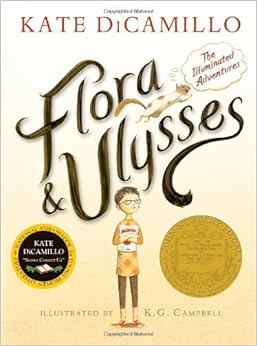
Flora & Ulysses: The Illuminated Adventures

http://ecx.images-amazon.com/images/I
/51whi5u8GDL._SY344_BO1,204,203,200_.jpg


Bibliography

DiCamillo, Kate.  Illus. by K.G. Campbell.  Flora & Ulysses: The Illuminated Adventures.  Somerville: Candlewick, 2013.  978-0-7636-6040-6


Summary

Comic-loving Flora is a self-declared cynic, but that doesn’t keep her from caring.  When her neighbor’s new vacuum accidentally sucks up a squirrel, Flora is there in flash to assist the poor creature.  This begins an unbelievable and amazing chain of events that will strengthen Flora’s family ties and intertwine her life with Ulysses, a poetry-writing Super Squirrel.

Analysis

Flora is a girl that the nerd in everyone will love.  The voice DiCamillo has created for her is strong and confident while she questions and works out the world around her.  The influence of her favorite comic book character gives her a unique way of seeing the world and quirky catch phrases, such as “Holy bagumba,” make Flora truly come to life.

All the characters in the book are overly dramatic and slightly odd, but these factors serve to make them more enjoyable and somehow more relatable.  In a story that teaches about love and believing in something, the character flaws of parents and neighbors serve as a lesson in understanding and compassion.  I also suspect that to young children of divorced parents, the absurdities I see as an adult may not seem quite as ridiculous. 

Every time Ulysses, the superhero squirrel, does something super, it is presented as a comic.  This adds to the story by further bringing Flora’s love of comics into the book.  It also brings Ulysses more to life.  The best part though, as a teacher, is that it bridges the gap between chapter books, picture books and comics.  With every passing year, more and more students are reluctant to read books that are predominantly made of words.  Flora and Ulysses helps these students to make the jump.

Awards and Reviews

*2014 Newbery Medal
*National Book Award Longlist

“When a neighbor accidentally vacuums a squirrel into a Ulysses 2000X vacuum cleaner, Flora resuscitates him into a “changed squirrel,” able to lift the 2000X with a single paw. Immediately assuming he’s a superhero, Flora names the squirrel “Ulysses” and believes together they will “[shed] light into the darkest corners of the universe.” Able to understand Flora, type, compose poetry and fly, the transformed Ulysses indeed exhibits superpowers, but he confronts his “arch-nemesis" when Flora’s mother tries to terminate him, triggering a chain of events where Ulysses becomes a real superhero. The very witty text and droll, comic-book–style black-and-white illustrations perfectly relay the all-too-hilarious adventures of Flora, Ulysses and a cast of eccentric characters who learn to believe in the impossible and have “capacious” hearts.
Original, touching and oh-so-funny tale starring an endearingly implausible superhero and a not-so-cynical girl.” –Kirkus

“Since Flora’s father and mother have split up, Flora has become a confirmed and defiant cynic. Yet it is hard to remain a cynic while one’s heart is opening to a squirrel who can type (“Squirtl. I am . . . born anew”), who can fly, and who adores Flora. Newbery winner DiCamillo is a master storyteller, and not just because she creates characters who dance off the pages and plots, whether epic or small, that never fail to engage and delight readers. Her biggest strength is exposing the truths that open and heal the human heart. She believes in possibilities and forgiveness and teaches her audience that the salt of life can be cut with the right measure of love. “ -Booklist


Connections

An interview with DiCamillo

Flora uses amazing vocabulary throughout the book.  Provide each student in class with an impressive word.  Students then will look up their word.  When they have an understanding of its meaning, they will create a one page comic to illustrate it.  Combine these comics into a Class Comic Dictionary.

The official book trailer

While they came to a reconciliation at the end of the book, throughout the book Flora and her mother were at odds over just about everything.  Choose one thing they disagreed about.  Write a letter from Flora to her mother (or vice versa) explaining the problem and providing a number of possible solutions.  Be sure to justify and explain Flora’s viewpoint and show kindness and respect.

Resources from the author


Flora shows great compassion for others throughout the book.  Research different local causes, such as animal shelters, soup kitchens or food banks.  Arrange to volunteer for the organization.  Can you turn your experience into a superhero comic?

The Most Excellent and Lamentable Tragedy of Romeo & Juliet: a play by William Shakespeare

http://ecx.images-amazon.com/images/I
/51yTOeZfsZL._SY344_BO1,204,203,200_.jpg


Bibliography

Hinds, Gareth. The Most Excellent and Lamentable Tragedy of Romeo & Juliet: a play by William Shakespeare.  Somerville: Candlewick Press, 2013.  978-0-7636-5948-6

Summary

A classic tale of forbidden love is given new life in the format of a graphic novel.  Two families, the Montagues and Capulets, are at eternal odds.  Their dislike for each other often turns to violence.  Despite this feud, young Romeo Montague and Juliet Capulet find each other and immediately fall hopelessly in love.  Tragedy is on the horizon for all, as young love deepens and the hatred between families grows.

Analysis

Beautiful illustrations bring Shakespeare’s original work to life in this modern adaptation.  Vivid watercolors capture the elegance and graces of the story, while Batman-style onomatopoeias bring action and movement to the words.  The modern format opens the work to a new generation of readers who may otherwise be put off to the antiquated style of writing.

Unfortunately, the comic style often hinders the original format.  Due to the small space for speech bubbles, the work is abridged and the iambic pentameter often destroyed by misplaced line breaks.  While there are sections of the book where the original lines have been preserved, the areas where design dominates verse are hard to read and lack the original power of Shakespeare’s writing. 

While Hinds’s work opens the door, those who are reluctant will likely still require assistance and care to learn to enjoy Shakespeare.  I am personally not a fan of reading Shakespeare’s works.  I found the graphic novel to be more pleasant than simply reading, but would not choose it over seeing the works acted out. 

Awards and Reviews

*YALSA 2014 Great Graphic Novels for Teens nomination
*Kirkus Best Teens Books 2013 selection

“Hinds as director, set designer and writer has expertly abridged the original text while embellishing it with modern sensibilities. His edition retains the flavor and poetry of the 1597 play and its memorable and oft-quoted dialogue. It is in the watercolor and digitally illustrated panels that he truly presents a stunning visual reading. Juliet and the Capulets are from India. Romeo and the Montagues are from Africa. Thus, the political rivalries of Verona become contemporary and more meaningful to 21st-century readers. The Capulets are dressed in reds and the Montagues in blue—all against the finely rendered lines of Verona’s buildings and Friar Laurence’s monastery. Beautiful shades of blue infuse the night sky as the two lovers swear their eternal devotion. The panels vary in size to control the pace of the plot. Sword fights pulse with energy and occasional karate thrusts for added drama. The most moving image—a double-page spread without words—is depicted from above in shades of gold and brown stained red with blood as Romeo and Juliet lie dead and immortalized in each other’s arms. As thrilling and riveting as any staging.” –Kirkus

“Cleaving to Shakespeare’s words and his dramatic arc, Hinds creates another splendid graphic novel, tracing each scene in taut, coherent, and expertly deployed dialogue. Hinds’s characters, in period array modified by a few more contemporary touches, are poignantly specific yet as universal as this tragic tale of young love demands. ... . Expertly pacing the drama with varied frames, often with sharp, action-propelling angles, Hinds explicates and amplifies Shakespeare’s story on every page, including wordless fight scenes that highlight pivotal details. ... From swirling action to subtly delineated emotion, he delivers the play’s essence and beauty, its glorious language, furious conflict, yearning love, and wrenching tragedy. This is not only a wonderfully accessible introduction to a full text or (better yet) theatrical production; it’s a visual delight for anyone.” –The Horn Book

Connections

Read, watch and act out Romeo and Juliet.  Write a comparison about how the different mediums affect your understanding and reaction to the play. 

Gareth Hinds’s Website

Hinds's Sketch Blog

Hinds has turned a number of other Shakespeare works into graphic novels, such as MacBeth and The Merchant of Venice.  Choose one of these titles to read.  Create separate Venn Diagrams comparing the illustrations, emotion, and main characters from the books.

A presentation by Hinds

Q&A with Hinds


Hinds took an old, famous story and made it his own.  Choose an old story that you love and give it new life.  Reinvigorate it any way you would like, such as making a graphic novel, filming a movie or creating a stop-action film.