Showing posts with label Fun. Show all posts

Friday, May 1, 2015

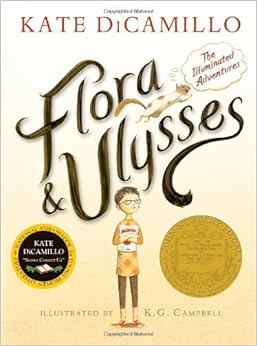
Flora & Ulysses: The Illuminated Adventures

http://ecx.images-amazon.com/images/I
/51whi5u8GDL._SY344_BO1,204,203,200_.jpg


Bibliography

DiCamillo, Kate.  Illus. by K.G. Campbell.  Flora & Ulysses: The Illuminated Adventures.  Somerville: Candlewick, 2013.  978-0-7636-6040-6


Summary

Comic-loving Flora is a self-declared cynic, but that doesn’t keep her from caring.  When her neighbor’s new vacuum accidentally sucks up a squirrel, Flora is there in flash to assist the poor creature.  This begins an unbelievable and amazing chain of events that will strengthen Flora’s family ties and intertwine her life with Ulysses, a poetry-writing Super Squirrel.

Analysis

Flora is a girl that the nerd in everyone will love.  The voice DiCamillo has created for her is strong and confident while she questions and works out the world around her.  The influence of her favorite comic book character gives her a unique way of seeing the world and quirky catch phrases, such as “Holy bagumba,” make Flora truly come to life.

All the characters in the book are overly dramatic and slightly odd, but these factors serve to make them more enjoyable and somehow more relatable.  In a story that teaches about love and believing in something, the character flaws of parents and neighbors serve as a lesson in understanding and compassion.  I also suspect that to young children of divorced parents, the absurdities I see as an adult may not seem quite as ridiculous. 

Every time Ulysses, the superhero squirrel, does something super, it is presented as a comic.  This adds to the story by further bringing Flora’s love of comics into the book.  It also brings Ulysses more to life.  The best part though, as a teacher, is that it bridges the gap between chapter books, picture books and comics.  With every passing year, more and more students are reluctant to read books that are predominantly made of words.  Flora and Ulysses helps these students to make the jump.

Awards and Reviews

*2014 Newbery Medal
*National Book Award Longlist

“When a neighbor accidentally vacuums a squirrel into a Ulysses 2000X vacuum cleaner, Flora resuscitates him into a “changed squirrel,” able to lift the 2000X with a single paw. Immediately assuming he’s a superhero, Flora names the squirrel “Ulysses” and believes together they will “[shed] light into the darkest corners of the universe.” Able to understand Flora, type, compose poetry and fly, the transformed Ulysses indeed exhibits superpowers, but he confronts his “arch-nemesis" when Flora’s mother tries to terminate him, triggering a chain of events where Ulysses becomes a real superhero. The very witty text and droll, comic-book–style black-and-white illustrations perfectly relay the all-too-hilarious adventures of Flora, Ulysses and a cast of eccentric characters who learn to believe in the impossible and have “capacious” hearts.
Original, touching and oh-so-funny tale starring an endearingly implausible superhero and a not-so-cynical girl.” –Kirkus

“Since Flora’s father and mother have split up, Flora has become a confirmed and defiant cynic. Yet it is hard to remain a cynic while one’s heart is opening to a squirrel who can type (“Squirtl. I am . . . born anew”), who can fly, and who adores Flora. Newbery winner DiCamillo is a master storyteller, and not just because she creates characters who dance off the pages and plots, whether epic or small, that never fail to engage and delight readers. Her biggest strength is exposing the truths that open and heal the human heart. She believes in possibilities and forgiveness and teaches her audience that the salt of life can be cut with the right measure of love. “ -Booklist


Connections

An interview with DiCamillo

Flora uses amazing vocabulary throughout the book.  Provide each student in class with an impressive word.  Students then will look up their word.  When they have an understanding of its meaning, they will create a one page comic to illustrate it.  Combine these comics into a Class Comic Dictionary.

The official book trailer

While they came to a reconciliation at the end of the book, throughout the book Flora and her mother were at odds over just about everything.  Choose one thing they disagreed about.  Write a letter from Flora to her mother (or vice versa) explaining the problem and providing a number of possible solutions.  Be sure to justify and explain Flora’s viewpoint and show kindness and respect.

Resources from the author


Flora shows great compassion for others throughout the book.  Research different local causes, such as animal shelters, soup kitchens or food banks.  Arrange to volunteer for the organization.  Can you turn your experience into a superhero comic?

Friday, March 27, 2015

Actual Size

http://ecx.images-amazon.com/images/I/
51qObTY8ZYL._SX258_BO1,204,203,200_.jpg


Bibliography

Jenkins, Steve.  Actual Size.  Boston: Houghton Mifflin, 2004.  0-618-37594-5

Summary

Everyone has seen a gorilla, at the zoo, on TV or in the pictures of a book.  The dark, furry face is familiar.  But just how big is a gorilla?  If you were to put your hand next to a gorilla’s hand, how would you compare?  This is one of the questions Steve Jenkins sets out to answer in Actual Size.  Just how big is the foot of the world’s largest land mammal?  How small is the world’s smallest primate?  Read to find out!

Analysis

Young children inevitably want to learn about the world around them, particularly about animals.  Beautiful art, simple language and concrete sizes make Actual Size a perfect selection to introduce young readers to nonfiction while satisfying their curiosities. 

Every page of the book has a plain white background, allowing the text and illustrations to pop.  The text is limited, with only a single sentence and a few measurement details on each page.  This allows each stunning illustration to be the focal point of the book.  Each picture is made, as the title suggests, in actual size.  Bound by the page size, this limits the reader to only seeing portions of many of the animals, giving a strong idea of how large they truly are.

If readers are not satisfied with the simple, one sentence hook from each page, they can reference the end of the book where each animal has a paragraph about them as well as a picture showing their full body, either at a distance or, for small animals, close up to see more detail.  While no sources are cited, Steve Jenkins’s reputation precedes him and gives credibility to the information. 

Awards and Reviews

*Orbis Pictus Honor Book
*Booklist Editor’s Choice
*Natural History Best Books for Young Readers, 2004

“In striking torn-and-cut paper collages, Jenkins depicts 18 animals and insects–or a part of their body–in actual size… Mixing deceptive simplicity with absolute clarity, this beautiful book is an enticing way to introduce children to the glorious diversity of our natural world, or to illustrate to budding scientists the importance of comparison, measurement, observation, and record keeping. A thoroughly engaging read-aloud and a must-have for any collection.–School Library Journal

“A new exploration of the biological world, from one of the current masters of collage, features life-size-not scaled-representations of the extremes of the animal kingdom. Wonderfully textured collages are set against a white background, accompanied by a minimal text gloss about the animals, and their sizes. Some are so huge that only parts can be seen (the one-foot-diameter eye of a giant squid) and others require some squinting (the 1/3-inch dwarf goby). It's a fascinating subject, and one that will resonate with an audience for whom relative size is a matter of daily interest. Jenkins exploits it for all its worth, including a fold-out of a crocodile's jaw and a snarling tiger whose face spills off the page. Four concluding pages provide more information about the featured animals, along with reasonably sized, full-body reiterations of the illustrations. Sadly enough, however, in a book that is so intimately concerned with measurement, only English units are used, seemingly ignoring the fact that the metric system is the universal language of science worldwide. A regrettable flaw in an otherwise outstanding offering.” – Kirkus Reviews

Connections

As a class, have students choose animals to research.  When their research is complete, have students make an actual size version of their animal.  Display the animals and invite others to visit the “Actual Size Zoo.”  Students can dress as zookeepers and inform the visitors about the animal they researched.

Steve Jenkins’s website

Jenkins uses torn paper to create his art.  Watch Jenkins explain his process (here or here).  Choose a scientific concept and have students illustrate it using the process Jenkins describes.

An interview with Jenkins

Read a number of Jenkins’s books and complete an author's study.  Look for similarities and differences in his books. 


Prepare a list of animal heights.  Have student measure these heights on paper then hang it in the room.  Compare the height of students to the animals.  Use these measurements as the basis of a math lesson on comparing. 

The Extraordinary Mark Twain (According to Susy)

http://www.barbarakerley.com/image/obj407geo407pg25p25.jpg


Bibliography

Kerley, Barbra.  Illustrated by Edwin Fotheringham.  The Extraordinary Mark Twain (According to Susy).  New York: Scholastic, 2010.  978-0-545-12508-6

Summary

Everyone knows Mark Twain, the creator of legendary characters such as Huckleberry Finn and Tom Sawyer.  It is likely that thousands of biographies have been written about his life, however there was one author who told a different story.  As she entered her teenage years, Twain’s daughter Susy took it upon herself to write a true biography of her father.  Susy was “a frank biographer and an honest one,” and she used “no sandpaper” in telling her father’s story.

Analysis

The Extraordinary Mark Twain (According to Susy) is not your typical biography.  Rather than give a large and detailed overview of Twain’s life, this book focuses on the relationship of father and daughter while giving a taste of Twain’s accomplishments and a glimpse into Susy’s world.  This unusual rendition creates an intriguing story that feels more like a work of fiction than the researched and historical account it is.  An extensive, page-by-page bibliography gives credit to the accuracy of the information while embedded quotations allow the personalities of Susy and Twain to shine through without bias or exaggeration.

The illustrations and layout support the text and further engage the reader in Susy’s story.  Deep, rich colors are a unifying factor in the illustrations, which vary from extremely detailed to simplistic silhouettes, keeping the reader interested in the art.  The biggest layout highlight may be the embedded pages from Susy’s journal, attached to the illustrations on every other page.  Rather than include the words from Susy’s journal entries in the text of the story, they are pulled out and placed as a book within a book, allowing the reader to open the journal entries separately.  Opening the journals and reading the italicized writing allows the reader to feel as though she is peering into Susy’s own journal, reading her original writing.

 Awards and Reviews

*2010 CYBILS Nonfiction Picture Book Award
*Best Children’s Books 2010 – Publisher’s Weekly
*Best Books 2010 – School Library Journal
*Texas Bluebonnet Award nominee

“Kerley and Fotheringham again craft a masterfully perceptive and largely visual biography, this time about the iconic 19th-century American writer. In pursuit of truth, Susy Clemens, age 13, vows to set the record straight about her beloved (and misunderstood) father and becomes his secret biographer. Kerley uses Susy's manuscript and snippets of wisdom and mirth from Twain's copious oeuvre as fodder for her story. The child's journal entries, reproduced in flowing handwritten, smaller folio inserts, add a dynamic and lovely pacing to the narrative, which includes little-known facts about Twain's work.  The text flawlessly segues into Susy's carefully recorded, sometimes misspelled, details of his character, intimate life, and work routine during his most prolific years....A delightful primer on researching and writing biographies, and a joy to peruse.” –SchoolLibrary Journal


“Kerley's conversational, quotation-rich narration effectively complements Susy's insights, and the result is an affectionate portrait of Twain as writer and family man…. Fotheringham's dynamically composed, digitally created full-bleed illustrations, both inventive and appealing, effectively recall the 19th-century setting, and big, swirling lines reflect the flourishes of an ink pen…. A heartwarming tribute to both the writing life in general and the well-loved humorist-oops, sorry Susy… ‘Pholosopher!’” –Kirkus Reviews 

Connections

Susy writes a biography to capture Mark Twain, his strengths and shortcomings.  Choose a member of your family.  In a journal format, write a biography that would give historians a clear picture of what they are like.


Barbra Kerley’s Website

Throughout the book, illustrator Edwin Fotheringham incorporated different types of writing into the book’s illustrations – Susy’s journal pages, a newspaper print, one of Twain’s letters that appears as though he is writing it.  Choose a writer or artist to research.  Create a picture book incorporating their writing or art in a similar fashion.

Give students more traditional biographies on Twain.  Have them compare and contrast the styles then write a review of each book explaining its benefits and drawbacks.  Have them include an explanation of which style they like more.