Showing posts with label Chapter Book. Show all posts

Monday, July 18, 2016

How I Live Now

http://smithsonianapa.org/bookdragon/wp-content/uploads/sites/10/2013/02/How-I-Live-Now.jpg


Bibliographic data:  

Rosoff, Meg (2004).  How I Live Now.  New York: Wendy Lamb Books.

 Summary:   

Immediately upon arrival, fifteen year old Daisy feels more at home with her cousins in their English country cottage than she ever did living with her father and stepmother in New York City.  This sense of home is disrupted when, only days after arriving, a bomb goes off in London and launches the whole country into war.  At first, Daisy and her cousins see the war as an exciting event that frees them from parental supervision, however soon enough the effects are disrupting their lives and upturning their world.

Analysis:

Rosoff has written How I Life Now in an interesting style that subtly allows the reader to get deep inside Daisy’s head.  The occasional untraditional capitalization, emphasis and sentence structure make the narration feel like the mind of a teenager, helping the reader to have a greater empathy and understanding of Daisy’s world.  This style would appeal to teenage readers while pulling them into the story.

Daisy is a multidimensional character, making a few very questionable choices while overall being a very caring, thoughtful girl.  Daisy is anorexic.  While this is not a major theme in the novel, it comes up multiple times throughout the book.  She makes it very clear that not eating is a decision that she has made because that she enjoys the control it gives her and her thinness.  After moving to England, she becomes romantically and sexually involved with her first cousin Edward.  She knows that what she is doing is wrong, but explains that it feels right and good, and states that with the war it seems like their family connection isn’t important.  When the war tears her family apart, she become a mother figure to her nine-year-old cousin Piper, with Daisy making a conscience effort to keep Piper safe and shielded while separated from her brothers.  At the beginning of the novel, Daisy is very willing to be taken care of but by the end she works very hard to make sure she can take care of others.

All these decisions and actions make Daisy a very believable character.  Because of her flaws and strengths, young readers would be able to easily relate and connect with her.  Daisy has a variety of struggles throughout the novel that she is able to work through, such as her eating disorder and losing a loved one, which some teens would be able to sympathize with and learn from Daisy’s experiences.
While being over a decade old, the novel is very relevant to today.  Daisy’s struggles are fairly timeless (a disliked stepmother, feeling replaced by a younger sibling, feeling out of control of her own life) but the war that is occurring in the book is startling similar to the world of today, being described as

Snipers and small groups of rebels everywhere, disorganized bands of covert fighters and half the time you couldn’t tell the Good Guys from the Bad Guys and neither could they.  Buses blew up, and occasionally an office building or a post office or a school…You could ask a thousand people on seven continents what it was all about and you wouldn’t get the same answer twice; nobody really knew for sure but you could bet one or more of the following words would crop up: oil, money, land, sanctions, democracy. (176)

If police violence and ISIS were added to the causes of the war, it could easily be a description of the events of this summer.  While these parts of the war are barely described in the novel, knowing that the context of the war is so similar to our current world gives a great meaning to Daisy’s experiences. 

Activity:  

Many popular novels of today take place in a postapocalyptic future, showing the aftermath of a great war that ravaged the world.  How I Live Now tells the story of what life was like while the world became ravaged.  While Daisy’s story is nicely wrapped up, little is said about how the world around her was affected by the war.  Readers could write their own postapocalypic story explaining the effect of the war.  Alternatively, How I Live Now could be paired with a postapocalyptic book such as the Hunger Games.  Readers could write the story between the war Daisy experienced and the world Katniss lives in, developing the story to explain how the war caused the postapocalyptic world to develop. 

 Related Resources:

During the war, Daisy and her cousin Piper are taken far from their home.  When the war takes a turn for the worst, the girls attempt to return home on foot.  They spend over a week traveling on footpaths and riverbeds, eating berries, nuts and mushrooms that they find and sleeping under a plastic tarp.  Their ability to survive is due in part to a survival kit that was given to them. The following websites give instructions and supply lists for making survival kits.

American Red Cross.  Be Prepared for an Emergency.  Retrieved from http://www.redcross.org/get-help/prepare-for-emergencies/be-red-cross-ready/get-a-kit (accessed July 18, 2016)

Department of Homeland Security.  Basic Disaster Supplies Kit. Retrieved from https://www.ready.gov/kit (accessed July 18, 2016)

Blair, Patrick.  How to Make Your Own Pill Bottle Survival Kit. Retrieved from http://survivalathome.com/pill-bottle-survival-kit/ (accessed July 18, 2016)


Daisy naturally overcomes her eating disorder in the novel by realizing it is absurd for her to refuse food when people are dying of starvation.  Beyond an explanation that she doesn’t eat and she enjoys the control, little else is said about Daisy’s condition.  This website gives information about anorexia and shares information on treating the disease. 

National Eating Disorder Association.  Anorexia Nevosa.  Retrieved from https://www.nationaleatingdisorders.org/anorexia-nervosa (accessed July 18, 2016)

National Eating Disorder Association.  Treatment. Retrieved from https://www.nationaleatingdisorders.org/treatment (accessed July 18, 2016)

Published Review:

“A 15-year-old, contemporary urbanite named Daisy, sent to England to summer with relatives, falls in love with her aunt's "oldy worldy" farm and her soulful cousins--especially Edmond, with whom she forms "the world's most inappropriate case of sexual obsession." Matters veer in a startling direction when terrorists strike while Daisy's aunt is out of the country, war erupts, and soldiers divide the cousins by gender between two guardians. Determined to rejoin Edmond, Daisy and her youngest cousin embark upon a dangerous journey that brings them face to face with horrific violence and undreamt-of deprivation. Just prior to the hopeful conclusion, Rosoff introduces a jolting leap forward in time accompanied by an evocative graphic device that will undoubtedly spark lively discussions. As for the incestuous romance, Daisy and Edmond's separation for most of the novel and the obvious emotional sustenance Daisy draws from their bond sensitively shift the focus away from the relationship's implicit (and potentially discomfiting) physical dimension. More central to the potency of Rosoff's debut, though, is the ominous prognostication of what a third world war might look like, and the opportunity it provides for teens to imagine themselves, like Daisy, exhibiting courage and resilience in roles traditionally occupied by earlier generations.”


Mattson, Jennifer. (2004).  How I Live Now. n.p.: Booklist, 20o4. Book Index with Reviews, EBSCOhost (accessed July 17, 2016).

Sunday, July 10, 2016

All the Light We Cannot See

http://the-toast.net/wp-content/uploads/2016/03/all_the_light.jpg


Bibliographic data:

Doerr, Anthony (2014).  All the Light We Cannot See.  Read by Zach Appleman.  New York: Simon & Schuster Audio.

Summary: 

Marie-Laure lives in Paris with her father.  When Marie-Laure goes blind at age 6, her father and his colleagues at Museum of Natural-History work together to ensure she is able to navigate her way though the world.  When the Nazi’s occupy Paris during World War II, Marie-Laure’s father is given an important task, which takes them away from the city to her uncle’s home on the coast.  Here, Marie-Laure’s life forever changes.

Werner is a German boy living in an orphanage with his younger sister.  He is mechanically minded, brilliant and ambitious.  After finding a broken radio, he teaches himself how to repair it.  Soon, he is repairing every radio in his small town.  These skills eventually take him to a Hitler youth academy where he builds his technical and emotional knowledge before joining the war. 
Without knowing of each other, Marie-Laure and Werner’s lives are deeply intertwined.  Do a radio, a diamond and a war have the power to bring them together?


Analysis: 

Written for older young adult readers, All the Light We Cannot See is a complicated read.  To begin, there are multiple story lines that cover multiple countries and years.  These stories are not told solely from the perspectives of Marie-Laure and Werner, but also half a dozen other characters.  In addition to these complicated aspects, the story is not presented chronologically.  The opening chapter has Marie-Laure in her uncle’s house as Saint-Malo is being bombed near the end of the war.  After this, we are with a young Werner in Germany, then Marie-Laure before she looses her vision.  These elements are engaging, however they require an advanced reader with solid comprehension skills.

While historically accurate, Marie-Laure and Werner are easily relatable.  Their concerns and thoughts mirror those of youth today, in spite of the darkness of their time period.  The powerlessness they feel, unable to fully control their lives, as well as their restlessness to want to be somewhere else are fairly universal themes for young people. 

It is interesting to have a story about World War II that tells the perspective of German citizens.  While there are many stories that speak to the tribulations those under the Nazi’s experienced, it is rare to hear the perspective of common Germans or Nazi soldiers.   This perspective would make an interesting discussion point to speak about group mindset, selfishness versus selflessness or to use as a writing prompt against a book such as Night by Elie Wiesel.

Activity:

Marie-Laure and Werner’s lives are interconnected due to radios.  Years before she was born, Marie-Laure’s grandfather and great-uncle produced a scientific radio program.  Marie-Laure’s uncle continues to broadcast the program using a transmitter in his attic.  As children, Werner and his sister find the program and love listening to the calm voice explain difficult scientific concepts. 

Readers will create their own children’s radio program.  The readers will decide on a topic on which they are experts.  They should create an outline of the key concepts that are important to the subject, and then write a script breaking these concepts down so that young children would be able to learn from their expertise.  When they are finished, they will record and publish their script to a site such as youtube.com.


Related Resources:

Every year for Marie-Laure’s birthday, she receives two gifts from her father: a Braille book and a homemade puzzle box with chocolates inside.  Despite her blindness, Marie-Laure is always able to quickly discover the secrets of his puzzle boxes, even though they often have more than a dozen steps to solve.

Puzzle Boxes: Fun and Intriguing Band Saw Projects would bring these puzzle boxes to life for a skilled reader.  The book provides instructions on how to create wooden puzzle boxes, just like the ones Marie-Laure received for her birthday.

Vollmer, Jeff. (2012).  Puzzle Boxes: Fun and Intriguing Band Saw Projects. Cincinnati: F+W Media.

Marie-Laure’s father works at the Paris Museum of Natural History.  Until the occupation of Paris, Marie-Laure accompanies him when he goes to work.  Here, the museum’s scientists and director teach Marie-Laure about the artifacts in the museum and encourage her curiosity about the scientific world.

Using the automatic translation feature of Google Chrome, English speaking readers can experience the modern day Paris museum through its website.  Of particular interest based on the book would be the Jewels of the Museum page, where gems and precious stones can be viewed or the Evolution of Living which features biological sciences.

Museum National D’Histoire Naturelle.  Retrieved from https://www.mnhn.fr/fr (accessed July 8, 2016)

Published Review:

“A novel to live in, learn from, and feel bereft over when the last page is turned, Doerr’s magnificently drawn story seems at once spacious and tightly composed. It rests, historically, during the occupation of France during WWII, but brief chapters told in alternating voices give the overall—and long—­narrative a swift movement through time and events. We have two main characters, each one on opposite sides in the conflagration that is destroying Europe. Marie-Louise is a sightless girl who lived with her father in Paris before the occupation; he was a master locksmith for the Museum of Natural History. When German forces necessitate abandonment of the city, Marie-Louise’s father, taking with him the museum’s greatest treasure, removes himself and his daughter and eventually arrives at his uncle’s house in the coastal city of Saint-Malo. Young German soldier Werner is sent to Saint-Malo to track Resistance activity there, and eventually, and inevitably, Marie-Louise’s and Werner’s paths cross. It is through their individual and intertwined tales that Doerr masterfully and knowledgeably re-creates the deprived civilian conditions of war-torn France and the strictly controlled lives of the military occupiers.High-Demand Backstory: A multipronged marketing campaign will make the author’s many fans aware of his newest book, and extensive review coverage is bound to enlist many new fans.”


Hooper, Brad. (2014).  All the Light We Cannot See. n.p.: Booklist, 2014. Book Index with Reviews, EBSCOhost (accessed July 8, 2016).

Monday, July 4, 2016

Rain is Not My Indian Name

http://d.gr-assets.com/books/1348084921l/1007345.jpg

Bibliographic data:

Leitich Smith, Cynthia (2001). Rain is Not My Indian Name.  Read by Jenna Lamia.  New York: Listening Library.

Summary

Cassidy Rain Berghoff knows grief all to well.  Her mother died when he was a child, and now, on the eve of her fourteenth birthday, her best friend Galen is struck by a car and dies during the night.  In response, Cassidy pulls herself inward, isolating herself from friends and family for months.  When Galen’s mourning mother tries to put a stop to the Indian youth camp her aunt has organized, Cassidy is pulled back into the world and forced to think about herself, her heritage and what’s best for everyone.

Analysis:            

Leitich Smith has created a likable, relatable character in Cassidy.  Because of, or perhaps in spite of, the great losses she has had in her life, Cassidy is down to earth and realistic.  She is a well-balanced character, possessing get self-confidence at times and extreme self-doubts at others.  She is perfectly flawed, she makes mistakes that hurt others and is hurt; yet at the same time she shows great compassion and empathy.  She understands the complexities of the people around her, while not understanding their puzzling choices and behaviors.

Cassidy’s questions and concerns are easy to relate to, even for those who are not part Native American.  Throughout the book, Cassidy attempts to figure out about relationships, her place in the world and why people treat each other as they do, all things that most teens can relate with.  Her experiences in the book are very universal, allowing both male and female readers to connect with the story. 

Rain Is Not My Indian Name would be a benefit to any multicultural library collection because Cassidy and her family are not the stereotype of Native Americans.  Often stories that feature Native characters take place in the distance past, preventing the characters from relating to modern youth.  With the exception of some outdated technology, Cassidy is clearly living in the now.  This is, unfortunately, a unique characteristic that makes Rain is Not My Indian Name an important addition to a young adult collection.


Activity

When reconnecting with the world after Galen’s death, Cassidy turns to her camera.  She takes photos of her aunt’s Indian Camp for the local newspaper, allowing her to be a part of camp while still being an outsider.  She focuses on the technical aspects of her photographs, the light and angles, to ensure that they capture the correct feel and emotion. 

Give readers either digital (preferred) or disposable cameras.   Have a number of still life scenes setup, lit using lamps and flashlights.  Allow the readers to experiment with different positions of the lights to create different shadows.  After this, instruct students that they will be taking portraits of each other to show various emotions, however there is a challenge.  No facial expressions are permitted; students must maintain a neutral face.  They may change their head position.  Students will have to use angle and lighting to create the desired effect. 


Related Resources:

One of positives of the book is that it portrays Native Americans doing modern day activities.  Cassidy’s older brother works in the technology industry designing webpages.  For many readers, the process of designing a webpage would be completely foreign.  Learning HTML for Kids is a basic guide on how to design a webpage.  If a reader finds this career choice intriguing, they can start designing their own sites.


Jeffers Goodell, Jill.  Learning HTML for Kids.  Retrieved from http://www.goodellgroup.com/tutorial/ (accessed July 3, 2016)

A major event throughout the book is the Indian Camp that Cassidy’s aunt is organizing.  The camp has a science and technology focus, with the campers experimenting to see how strong they can build a bridge made from spaghetti noodles and Elmer’s glue.  To further the importance of science and technology, readers could do their own experiments.  Scholastic Inc has put together a list of fun videos with experiments that students could recreate or use as inspiration.

http://www.scholastic.com/teachers/article/40-cool-science-experiments-web

Scholastic Inc.  40 Cool Science Experiments on the Web.  Retrieved from http://www.scholastic.com/teachers/article/40-cool-science-experiments-web (accessed July 3, 2016)

Published Review:

“Multiple plot lines and nonlinear storytelling may make it difficult to enter Smith's (Jingle Dancer) complex novel, but the warmth and texture of the writing eventually serve as ample reward for readers. The sensitive yet witty narrator, 14-year-old Cassidy Rain Berghoff, grows up in a small Kansas town as one of the few people with some Native American heritage. That experience alone might challenge Rain, but Smith creates a welter of conflicts. Rain's mother is dead (she was struck by lightning), and as the novel opens, her best friend is killed in a car accident just after he and Rain realize their friendship has grown into romance. Six months later, her older brother urges her to go to her great-aunt's Indian Camp. At first she shrugs it off, but later volunteers to photograph the camp for the town paper and begins to share her Aunt Georgia's commitment to it. When public funding for the camp becomes a contested issue in the city council, Rain decides to enroll. Some of Smith's devices such as opening each chapter with a snippet from Rain's journal add depth and clarify Rain's relationships for readers, although other elements (the detailing of song lyrics playing in the background, for instance) seem stilted. Even so, readers will feel the affection of Rain's loose-knit family and admire the way that they, like the author with the audience, allow Rain to draw her own conclusions about who she is and what her heritage means to her.”

2001. Rain is Not My Indian Name. n.p.: Publisher’s Weekly, 2001. Book Index with Reviews, EBSCOhost (accessed July 3, 2016).   

Monday, June 27, 2016

Are You there God? It's me, Margaret.

http://d.gr-assets.com/books/1388356524l/37732.jpg

Bibliographic data

Blume, Judy (1970). Are You There God?  It’s Me, Margaret.  New York: Atheneum Books.

Summary:  

Margaret is a stereotypical eleven-year-old American girl.  Following a move to New Jersey, Margaret quickly makes friends with her new neighbor, Nancy.  She is introduced to her classmates and her new teacher, Mr. Benedict.  As she adjusts to her new life, she questions religion, learns about puberty and finds out what kinds of friends she really has made.   

Analysis:  

Are You There God?  It’s Me, Margaret, is a story most preteen girls could relate to.  Throughout the book, Margaret pleads with God to simply be normal – a feeling most fifth or sixth graders often have.  For Margaret, being normal has a number of different meanings.  She wants to physically be normal.  She and her friends are eager to get their first periods and “increase [their] busts.”  At the same time, these milestones make her feel awkward and unsure.  She worries that if her secret crush, a friend of a friend’s older brother, is discovered she would be made fun of.  Young girls would be able to see themselves in these struggles of Margaret’s, and learn from her experiences.

Margaret also wants to be religiously normal.  Her parents had different religious upbringings and abandoned all religion when they were married.  While Margaret writes to God in her journal, she has never attended church or synagogue, which is completely unheard of in her new hometown.   Throughout the novel is attends services of different faiths and begs God to help her feel something towards one of them.  This is an unusual theme in books for preteens, however is very relevant as many girls are going through confirmation or preparing for their Bat Mitzvah.

While often considered controversial and on banned book lists, Blume has created a novel that accurately portrays the turmoil of being a young woman.  Margret shows the mind of a sixth grader, with sixth grade worries and troubles.  The most risqué scene involves the entire sixth grade class playing spin the bottle and two minutes in heaven, however the kisses described are primarily pecks on the cheek. Those with firm religious beliefs may be put off by her casual relationship with God, however her search for truth is one that many religious faiths encourage at her age.  Margaret’s turmoil about where she belongs will be relatable to many girls who are questioning their personal beliefs.

This is a book that girls will be able to relate to and enjoy; a downfall is that boys would not, particularly not preteen boys.  The books focuses too much on girl topics, such as menstruation, bras and crushes, for boys to feel comfortable reading it.  Blume has written a similar book, Then Again, Maybe I Won’t, with a male main character that boys would be better able to relate to. 

Activity:  

For her sixth grade project, Margaret studies and considers what religion would be best suited for her.  She attends a number of religious services and confession, however the beliefs of the faiths she explores are not discussed.  To extend this search of Margaret’s for readers, guest speakers from different religions could be asked to speak about the similarities and differences in their creeds and answer any looming questions readers have.

Related Resources:

Throughout the book, Margaret and her friends discuss their changing bodies at length.  They are curious about what is to come.  Many young girls will likely have similar questions.  For those who are too shy to ask an adult, a website such as girlshealth.gov could be useful.  This site has articles covering many topics that Margaret has concerns over in the book, from puberty and crush to bullying and friendships.

Office on Women’s Health.  Girlshealth.  Retrieved from http://www.girlshealth.gov/ (accessed June 24, 2016)

Margaret’s adventures are told through a combination of narrated stories and diary entries.  After reading Margaret’s journal, readers may be inspired to write their own thoughts and concerns down.  The Care & Keeping of YOU: Journal 1 for Younger Girls provides a guided journal for young girls to reflect on their life, as well as information about common questions and concerns.

Natterson, Cara (2013).  The Care & Keeping of YOU: Journal 1 for Younger Girls.  Middleton: American Girl Publications:

Published Review:

“The comical longings of little girls who want to be big girls -- exercising to the chant of "We must -- we must -- increase our bust!" -- and the wistful longing of Margaret, who talks comfortably to God, for a religion, come together as her anxiety to be normal, which is natural enough in sixth grade. And if that's what we want to tell kids, this is a fresh, unclinical case in point: Mrs. Blume (Iggie's House, 1969) has an easy way with words and some choice ones when the occasion arises. But there's danger in the preoccupation with the physical signs of puberty -- with growing into a Playboy centerfold, the goal here, though the one girl in the class who's on her way rues it; and with menstruating sooner rather than later -- calming Margaret, her mother says she was a late one, but the happy ending is the first drop of blood: the effect is to confirm common anxieties instead of allaying them. (And countertrends notwithstanding, much is made of that first bra, that first dab of lipstick.) More promising is Margaret's pursuit of religion: to decide for herself (earlier than her 'liberal' parents intended), she goes to temple with a grandmother, to church with a friend; but neither makes any sense to her -- "Twelve is very late to learn." Fortunately, after a disillusioning sectarian dispute, she resumes talking to God. . . to thank him for that telltale sign of womanhood. Which raises the last question: of a satirical stance in lieu of a perspective.

Kirkus Review (1970).  Are You There God?  It’s Me, Margaret. n.p.: Kirkus Reviews. Retrieved from https://www.kirkusreviews.com/book-reviews/judy-blume/are-you-there-god-its-me-margaret/. Last updated October 2011.  (accessed June 25, 2016).

Tuesday, June 21, 2016

Midwinterblood

https://images-na.ssl-images-amazon.com/images/I/51i2zGO-gJL._SX331_BO1,204,203,200_.jpg

Bibliographic data

Sedgwick, Marcus (2014).  Midwinterblood.  Read by Julian Rhind-Tutt.  New York: Listening Library.

Summary:  

Midwinterblood is comprised of seven short stories, each its own story but all connected by an island and two names, Merle and Erik.  Spanning thousands of years, each story is its own, telling of a journalist, archeologist, painter, farmer, fighter pilot, king and nanny.  Each story, however, has elements that are relate to the others: a hare, a phrase, a flower.  Could these stories, despite their differences and the years between them, be intertwined?

Analysis:  

Midwinterblood is an engaging, well-written and thought-out book.  Sedgwick managed to create seven stories that could easily stand on their own but instead group together to make a stronger, more compelling book.  With each new story, the reader becomes more certain that the Eriks and Merles from each story are somehow connected.  Each story provides the reader with the smallest hint of how the stories connect, hints that are often not obvious until a number of stories later.  This interconnectedness draws the reader in, making Midwinterblood an easy page-turner.

Because it is comprised of a number of short stories, there is a story line for nearly everyone.  The short story genres range from ghost stories to historical fiction, realistic fiction to mystery.  This variety makes Midwinterblood an ideal read for book groups or classroom assignments.  The variety is complimented by foreshadowing and reoccurring ideas, making it easy to make predictions about what is to come in the novel and discuss theories of how, or if, the stories are related.
Midwinterblood does not have the feel of a young adult novel.  The characters are not anxious teens attempting to discover themselves, but rather a mix of young and old, males and females.  This is likely to catch some young adults off guard.  The uniqueness of the story line will engage some young readers, while others might be unable to connect to the book without seeing more of themselves in the characters.

The audio reading is well done overall.  Julian Rhind-Tutt creates a variety of voices, allowing the multitude of characters to come to life.  The musical selection that plays between the stories matches the feel of the novel, mysterious and ancient.  Towards the end of the book however, Rhind-Tutt’s voice trails off awkwardly at the end of sentences, leaving the listener in a constant state of discomfort as he or she wonders if the chapter is ending or if there are errors with the playback.

Activity:  

A class could use the unique combined short story style of Midwinterblood as a starting point for a collaborative writing project.  To begin, all students could be given two names.  Each individual or small group could then compose a short story with two characters that have the assigned names. There should be no restraints on how the names are connected or used.  After this writing is complete, the individual writers would share their writing with the class.  Then, as a whole group, the class would brainstorm and write an overarching story that connects all of the short stories.

Related Resources: 

The connection between the stories in Midwinterblood is an ancient human sacrifice.   In an attempt to appease the gods and his people for years of bad crops, King Erik offers himself.  As he dies, he promises his wife, Merle, that they will live seven times and that he will find her.  European human sacrifice is likely an unknown topic for young adult readers, this site from the BBC will provide them with background knowledge on the subject.

Parker-Pearson, Mike (2011).  The Practice of Human Sacrifice.  Retrieved from http://www.bbc.co.uk/history/ancient/british_prehistory/human_sacrifice_01.shtml  (accessed June 20, 2016).

One of the stories in Midwinterblood tells of a famous painter who creates a giant painting depicting a scene of a primitive human sacrifice.  This sacrifice is central to the story and is titled “Midwinterblood”.  The painting however was not an idea original to Sedgwick.  He based the story off a painting created in 1915 by Carl Larsson titled “Midvinterblot,” which is housed at the Swedish National Museum.  Larsson’s painting does not match Sedgwick’s description exactly, however the similarities are obvious.  The following links tell more about Larsson, show examples of his work and tell about “Midvinerblot.”  This background knowledge could help the reader to better understand Sedgwick’s writing process as well as to visualize the painting and sacrifice scene from the book. 

Hernan, Oriol. Carl Larsson Paintings.  Retrieved from https://www.youtube.com/watch?v=dnrTJvpmynk (accessed June 20, 2016)

Oakley, Howard.  Carl Larsson: how a loved and popular painter became lost in controversy.  Retrieved from https://eclecticlight.co/2015/11/22/carl-larsson-how-a-loved-and-popular-painter-became-lost-in-controversy/  (accessed June 20, 2016).

National Museum.  Midvinterblot: Sweden’s Most Controversial Painting.  Retrieved from: http://www.nationalmuseum.se/ (https://goo.gl/qeEM81 ) (accessed June 20, 2016).  Translated using https://translate.google.com/.   

Published Review:

“Ominous drumbeats and solemn music introduce each intertwined story in the audio of Sedgwick’s Printz Award–winning fantastical and bleak tale. Each story works its way backward in time, exploring the lives of reincarnated lovers Eirikr and Melle, a Dark Ages king sacrificed for his people and the wife he asked to follow him through centuries of rebirth. All set on the island of Blessed, these tales are spooky and strange and bordering on the horrific. A Viking spurned by his lover—his brother’s wife—tries to reclaim his children, even after death, stalking the island seeking blood. A wraith masquerading as a nanny tells her ghostly tale to two unsuspecting children visiting the island. Rhind-Tutt’s voice is supple and full of gravitas, able to command as well as purr. Like a bard of yore, he grips the listener, though because some of the main narrators and characters are women, and young as well as old, it can be difficult to sort out relationships at times. This is an excellent choice for those seeking chills—just don’t listen alone at night, during a thunderstorm.”
Cruse, Karen. 2014. Miswinterblood. n.p.: Booklist, 2014. Book Index with Reviews, EBSCOhost (accessed June 20, 2016).

Midwinterblood is comprised of seven vignettes, with settings ranging from the future to Viking times and a variety of characters, including vampires, ghosts, and humans. Common to all the stories is the Scandinavian island, Blessed; a mysterious dragon orchid; and Eric and Merle, who play different roles in each story. This unusual book for teens (many of the stories feature adult characters only) goes backwards in time, beginning with a story that takes place in 2073. While each narrative could stand alone, combining them into one volume with the barest threads of connections (similar to Olive Kitteridge or Let the Great World Spin) makes the book noteworthy. The audiobook is expertly narrated by British actor Julian Rhind-Tutt, whose hushed English voice is perfect for the recording. Sedgwick's sparse prose is beautifully read with a haunting, dreamlike quality that lets listeners experience the horror, mystery, romance, and tragedy that abounds in the book. Melancholy yet lovely music briefly separates the vignettes.
Paladino, Julie. 2014. Miswinterblood. n.p.: School Library Journal, 2014. Book Index with Reviews, EBSCOhost (accessed June 20, 2016).

Tuesday, June 14, 2016

Z for Zachariah

https://images-na.ssl-images-amazon.com/images/I/51rqbjzojiL._SX356_BO1,204,203,200_.jpg


Bibliographic data: 

O'Brien, R. C. (2002). Z for zachariah. New York: Simon Pulse.

Summary  

After a weeklong war, the United States has been ravaged by a nuclear holocaustic.  Everything and everyone is dead, with the exception of sixteen-year-old Ann Burden.  Thanks to an unusual weather pattern, the valley she calls home is unaffected by the radioactive fall out.  She believes she is the last person alive…until Mr. Loomis appears in a radioactive safe suit.

Analysis  

Written as if reading Ann’s diary, Z for Zachariah is an engaging page-turner.  Unlike many dystopian books, Ann does not focus on survival.  Her agricultural upbringing has taught her the skills needed to meet her physical needs.  The fact that she may be the only person left alive in the country doesn’t seem to upset her much, she is too busy working to survive.  The conflict in the story is the relationship between Ann and Mr. Loomis.

Ann’s behavior in the novel is mystifying.  To start, she is strong and independent.  She runs her family’s farm on her own, keeping herself not only alive but also thriving, for over a year.  Yet, when Mr. Loomis appears Ann seems incapable of standing up for herself.  Mr. Loomis begins to dictate how the farm will be run, at times forcefully preventing Ann from completing tasks.  Ann rarely questions Mr. Loomis and continues to care for him, determined to keep him alive.  Even after Mr. Loomis attempts to physically harm Ann and she decides to move into the hills to be away from him, she continues to ensure that he has adequate food and is well taken care of. 

This inability to standup for herself goes against everything that society is working to teach girls.  While on her own, Ann is strong but she immediately bows when a man appears.  This is frustrating to see, however it could be an extremely beneficial novel for young girls who are in similar situations.  Ann is able to justify her loyalties to Mr. Loomis, she justifies his behaviors even when, to the reader, his actions are irrepressible.   Young girls who are developing their inner strength may be able to see themselves or their situations in Ann. 

Z for Zachariah would be an interesting book for young adults who enjoy stories about dystopian futures.  It is old enough that it provides a different prospective, rather than zombies or authoritarian governments, it is a nuclear holocaust; rather than fighting to survive, it focuses on the interactions and mindset of the characters.  It would be an interesting choice to compare against popular novels of today, such as the Hunger Games or The Maze Runner. 

Activity  

In a world without budget constraints, it would be amazing to present the readers with an opportunity to experience some of the farm work that is discussed in the novel, particularly for urban teens.  This could be done through a series of guest speakers that can discuss and educate on crops and animals, a small garden could be setup at outside the library for students to tend to or a trip could be arranged to visit a working farm.  Readers could engage in the activities that Ann does, such as caring for chickens, milking cows and farming by hand. 

 Related Resources  

The video “Nuclear War’s Worst-case scenario” could be used to engage students before reading.  The book begins a year after nuclear weapons were dropped.  In this video, clips from a number of Cold War and films about nuclear weapons have been put together to replicate what would happen during a nuclear attack.  The video would set the scene for what the world around Ann would be like.
Cdcollura. (2012). Nuclear war's worst-case scenario (nobody wins). Retrieved from https://www.youtube.com/watch?v=BRWzNIaVyBs


Ann survives the destruction around her by farming.  For many teens in America, farming is completely foreign.  The Farm School is exactly what it sounds like, a school where the subject is farming.  They offer a yearlong course for adults, 3-day field trips for students and summer camps for kids and teens.  For a large undertaking or for students who are particularly interested in Ann’s way of life, this could be a resource to gain an understanding of this skill set.  Additionally, they have a resource section of their website that students could utilize to learn more about agriculturally based life.
The farm school. Retrieved from http://farmschool.org/


Published Review

“Z is for Zachariah, the last name in fifteen-year-old Ann Burden's Bible school alphabet book; it's also for zero population after nuclear bombs and nerve gas seem to have destroyed everyone in the world except Ann in her Amish country valley (her family left it and seem singularly unregretted but then Ann is one of those unthinking practical types) who is making it alone with her brother's dog Faro, with their cow, chickens, the diminishing supplies from the store and her garden. Until a stranger comes over the hill in his plastic safe-suit -- he'd killed to get it; he has a bout of radiation sickness and almost dies but Ann brings him back to health only to face a lethal gratitude on his part. Mr. O'Brien wrote two juveniles as well as another genocidal thriller, A Report from Group 17. This is a little of each for both audiences and you'll find Ann's level resourcefulness as insulating as that safe-suit. So, less convincingly so, is her abz naivete in a day and age which has just come to an end.”

O'Brien, Robert C. 1975. Z for Zachariah. n.p.: Atheneum, 1975. Book Index with Reviews, EBSCOhost (accessed June 11, 2016).

Friday, May 1, 2015

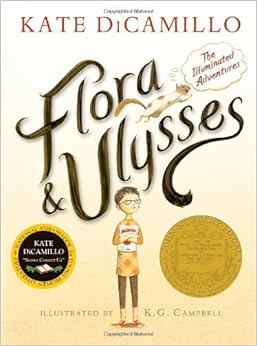
Flora & Ulysses: The Illuminated Adventures

http://ecx.images-amazon.com/images/I
/51whi5u8GDL._SY344_BO1,204,203,200_.jpg


Bibliography

DiCamillo, Kate.  Illus. by K.G. Campbell.  Flora & Ulysses: The Illuminated Adventures.  Somerville: Candlewick, 2013.  978-0-7636-6040-6


Summary

Comic-loving Flora is a self-declared cynic, but that doesn’t keep her from caring.  When her neighbor’s new vacuum accidentally sucks up a squirrel, Flora is there in flash to assist the poor creature.  This begins an unbelievable and amazing chain of events that will strengthen Flora’s family ties and intertwine her life with Ulysses, a poetry-writing Super Squirrel.

Analysis

Flora is a girl that the nerd in everyone will love.  The voice DiCamillo has created for her is strong and confident while she questions and works out the world around her.  The influence of her favorite comic book character gives her a unique way of seeing the world and quirky catch phrases, such as “Holy bagumba,” make Flora truly come to life.

All the characters in the book are overly dramatic and slightly odd, but these factors serve to make them more enjoyable and somehow more relatable.  In a story that teaches about love and believing in something, the character flaws of parents and neighbors serve as a lesson in understanding and compassion.  I also suspect that to young children of divorced parents, the absurdities I see as an adult may not seem quite as ridiculous. 

Every time Ulysses, the superhero squirrel, does something super, it is presented as a comic.  This adds to the story by further bringing Flora’s love of comics into the book.  It also brings Ulysses more to life.  The best part though, as a teacher, is that it bridges the gap between chapter books, picture books and comics.  With every passing year, more and more students are reluctant to read books that are predominantly made of words.  Flora and Ulysses helps these students to make the jump.

Awards and Reviews

*2014 Newbery Medal
*National Book Award Longlist

“When a neighbor accidentally vacuums a squirrel into a Ulysses 2000X vacuum cleaner, Flora resuscitates him into a “changed squirrel,” able to lift the 2000X with a single paw. Immediately assuming he’s a superhero, Flora names the squirrel “Ulysses” and believes together they will “[shed] light into the darkest corners of the universe.” Able to understand Flora, type, compose poetry and fly, the transformed Ulysses indeed exhibits superpowers, but he confronts his “arch-nemesis" when Flora’s mother tries to terminate him, triggering a chain of events where Ulysses becomes a real superhero. The very witty text and droll, comic-book–style black-and-white illustrations perfectly relay the all-too-hilarious adventures of Flora, Ulysses and a cast of eccentric characters who learn to believe in the impossible and have “capacious” hearts.
Original, touching and oh-so-funny tale starring an endearingly implausible superhero and a not-so-cynical girl.” –Kirkus

“Since Flora’s father and mother have split up, Flora has become a confirmed and defiant cynic. Yet it is hard to remain a cynic while one’s heart is opening to a squirrel who can type (“Squirtl. I am . . . born anew”), who can fly, and who adores Flora. Newbery winner DiCamillo is a master storyteller, and not just because she creates characters who dance off the pages and plots, whether epic or small, that never fail to engage and delight readers. Her biggest strength is exposing the truths that open and heal the human heart. She believes in possibilities and forgiveness and teaches her audience that the salt of life can be cut with the right measure of love. “ -Booklist


Connections

An interview with DiCamillo

Flora uses amazing vocabulary throughout the book.  Provide each student in class with an impressive word.  Students then will look up their word.  When they have an understanding of its meaning, they will create a one page comic to illustrate it.  Combine these comics into a Class Comic Dictionary.

The official book trailer

While they came to a reconciliation at the end of the book, throughout the book Flora and her mother were at odds over just about everything.  Choose one thing they disagreed about.  Write a letter from Flora to her mother (or vice versa) explaining the problem and providing a number of possible solutions.  Be sure to justify and explain Flora’s viewpoint and show kindness and respect.

Resources from the author


Flora shows great compassion for others throughout the book.  Research different local causes, such as animal shelters, soup kitchens or food banks.  Arrange to volunteer for the organization.  Can you turn your experience into a superhero comic?

The Book Thief

http://upload.wikimedia.org/wikipedia/en/8/8f/
The_Book_Thief_by_Markus_Zusak_book_cover.jpg


Bibliography

Zusak, Markus.  The Book Thief.  New York: Knopf, 2005.  978-0-375-84220-7

Summary

Liesel was not born a thief, it is a habit she has decided to cultivate and develop.  Stealing books gives her something she can control in an otherwise uncontrollable world.  Given up by her mother, watching her brother die, and living in a nation being torn apart of the atrocities of Hitler and World War Two, there is little else in her life she has power over.  While stealing away her books, Liesel learns to hope from those around her, discovers a new family and learns compassion in ways she never could imagine.

Analysis

While stories of the Holocaust and Hitler are popular these days, The Book Thief stands out.  To begin, it does not tell the story of concentration camps or Jews, but rather the life of a young, average, German girl.  Rather than focusing on the atrocities experienced by the persecuted, Zusak illustrates the everyday struggles of the poor and under-educated; a population easily over looked by history due to their lack of involvement or direct suffering during the war.  To add to this unique perspective, The Book Thief is voiced by a narrator who, while a major player in World War Two is rarely heard directly from; that of Death himself.

It seems only appropriate that Death would narrate a novel that is set in Germany in the midst of World War Two.  The voice that Zusak has created for him is somehow equally unexpected and absolutely perfect.  Death is cool and causal about the events of the human world around him, painting a picture of the world Liesel lives in without becoming overly connected to the humans he passes and carries.  At the same time, he is able to express all the anguish, fear and hope those who live with Liesel on Himmel Street experience, giving insights that allow the reader to connect with every major character in the book.

Of all the characters, Liesel and her Papa, Hans, are the most likeable.  Every action they take shows the depth of their compassion and the quality of their characters.  While the rest of Germany appears to have aligned their beliefs with Hitler, Hans does what is right and not popular, despite the repercussions he faces.  Liesel, in her own, more selfish way, also does what is right; rather than live illiterate and uneducated, she searches for opportunities to steal knowledge and learning.  Together, they work to make the best of the bad situation they have been given, eternally optimists.

Awards and Reviews

*SLJ Best Book of the Year
*Michael L. Printz Honor Book
*National Jewish Book Award for Children’s and Young Adult Literature
*Daniel Elliott Peace Award

The Book Thie’ is perched on the cusp between grown-up and young-adult fiction, and it is loaded with librarian appeal. It deplores human misery. It celebrates the power of language. It may encourage adolescents to read. It has an element of the fanciful. And it's a book that bestows a self-congratulatory glow upon anyone willing to grapple with it….
To be sure, The Book Thief attempts and achieves great final moments of tear-jerking sentiment. And Liesel is a fine heroine, a memorably strong and dauntless girl. But for every startlingly rebellious episode — Rudy's Führer-baiting impersonation of the black American athlete Jesse Owens, the building of an indoor snowman for a Jew in hiding, the creation of books and drawings that frame Liesel and Max's experiences as life-affirming fairy tales — there are moments that are slack.
The Book Thief will be appreciated for Mr. Zusak's audacity, also on display in his earlier I Am the Messenger. It will be widely read and admired because it tells a story in which books become treasures. And because there's no arguing with a sentiment like that.”  -New York Times

“When Death tells a story, you pay attention. Liesel Meminger is a young girl growing up outside of Munich in Nazi Germany, and Death tells her story as “an attempt—a flying jump of an attempt—to prove to me that you, and your human existence, are worth it.” When her foster father helps her learn to read and she discovers the power of words, Liesel begins stealing books from Nazi book burnings and the mayor’s wife’s library. As she becomes a better reader, she becomes a writer, writing a book about her life in such a miserable time. Liesel’s experiences move Death to say, “I am haunted by humans.” How could the human race be “so ugly and so glorious” at the same time? This big, expansive novel is a leisurely working out of fate, of seemingly chance encounters and events that ultimately touch, like dominoes as they collide. The writing is elegant, philosophical and moving. Even at its length, it’s a work to read slowly and savor. Beautiful and important.” –Kirkus

Connections

Read Night by ElieWiesel or Maus by Art Spiegelman.  Using what you learned about Max from the The Book Thief and the image of life in the concentration camps created by the other book, create a journal or narrative of Max’s life after the Germans captured him. 

Liesel is around the same age as Dewey from The Green Glass Sea and alive during the same time period, however their life experiences are very different.  Write a script of a conversation between the two girls about their experiences during World War Two.

Watch the movie version of The Book Thief.  Compare and contrast the two stories. Which version do you like more?  Why?

Markus Zusak writes about his book being made into a movie.


An interview with Zusak

Zusak’s Twitter