Showing posts with label Picture Books. Show all posts

Friday, March 27, 2015

Actual Size

http://ecx.images-amazon.com/images/I/
51qObTY8ZYL._SX258_BO1,204,203,200_.jpg


Bibliography

Jenkins, Steve.  Actual Size.  Boston: Houghton Mifflin, 2004.  0-618-37594-5

Summary

Everyone has seen a gorilla, at the zoo, on TV or in the pictures of a book.  The dark, furry face is familiar.  But just how big is a gorilla?  If you were to put your hand next to a gorilla’s hand, how would you compare?  This is one of the questions Steve Jenkins sets out to answer in Actual Size.  Just how big is the foot of the world’s largest land mammal?  How small is the world’s smallest primate?  Read to find out!

Analysis

Young children inevitably want to learn about the world around them, particularly about animals.  Beautiful art, simple language and concrete sizes make Actual Size a perfect selection to introduce young readers to nonfiction while satisfying their curiosities. 

Every page of the book has a plain white background, allowing the text and illustrations to pop.  The text is limited, with only a single sentence and a few measurement details on each page.  This allows each stunning illustration to be the focal point of the book.  Each picture is made, as the title suggests, in actual size.  Bound by the page size, this limits the reader to only seeing portions of many of the animals, giving a strong idea of how large they truly are.

If readers are not satisfied with the simple, one sentence hook from each page, they can reference the end of the book where each animal has a paragraph about them as well as a picture showing their full body, either at a distance or, for small animals, close up to see more detail.  While no sources are cited, Steve Jenkins’s reputation precedes him and gives credibility to the information. 

Awards and Reviews

*Orbis Pictus Honor Book
*Booklist Editor’s Choice
*Natural History Best Books for Young Readers, 2004

“In striking torn-and-cut paper collages, Jenkins depicts 18 animals and insects–or a part of their body–in actual size… Mixing deceptive simplicity with absolute clarity, this beautiful book is an enticing way to introduce children to the glorious diversity of our natural world, or to illustrate to budding scientists the importance of comparison, measurement, observation, and record keeping. A thoroughly engaging read-aloud and a must-have for any collection.–School Library Journal

“A new exploration of the biological world, from one of the current masters of collage, features life-size-not scaled-representations of the extremes of the animal kingdom. Wonderfully textured collages are set against a white background, accompanied by a minimal text gloss about the animals, and their sizes. Some are so huge that only parts can be seen (the one-foot-diameter eye of a giant squid) and others require some squinting (the 1/3-inch dwarf goby). It's a fascinating subject, and one that will resonate with an audience for whom relative size is a matter of daily interest. Jenkins exploits it for all its worth, including a fold-out of a crocodile's jaw and a snarling tiger whose face spills off the page. Four concluding pages provide more information about the featured animals, along with reasonably sized, full-body reiterations of the illustrations. Sadly enough, however, in a book that is so intimately concerned with measurement, only English units are used, seemingly ignoring the fact that the metric system is the universal language of science worldwide. A regrettable flaw in an otherwise outstanding offering.” – Kirkus Reviews

Connections

As a class, have students choose animals to research.  When their research is complete, have students make an actual size version of their animal.  Display the animals and invite others to visit the “Actual Size Zoo.”  Students can dress as zookeepers and inform the visitors about the animal they researched.

Steve Jenkins’s website

Jenkins uses torn paper to create his art.  Watch Jenkins explain his process (here or here).  Choose a scientific concept and have students illustrate it using the process Jenkins describes.

An interview with Jenkins

Read a number of Jenkins’s books and complete an author's study.  Look for similarities and differences in his books. 


Prepare a list of animal heights.  Have student measure these heights on paper then hang it in the room.  Compare the height of students to the animals.  Use these measurements as the basis of a math lesson on comparing. 

The Extraordinary Mark Twain (According to Susy)

http://www.barbarakerley.com/image/obj407geo407pg25p25.jpg


Bibliography

Kerley, Barbra.  Illustrated by Edwin Fotheringham.  The Extraordinary Mark Twain (According to Susy).  New York: Scholastic, 2010.  978-0-545-12508-6

Summary

Everyone knows Mark Twain, the creator of legendary characters such as Huckleberry Finn and Tom Sawyer.  It is likely that thousands of biographies have been written about his life, however there was one author who told a different story.  As she entered her teenage years, Twain’s daughter Susy took it upon herself to write a true biography of her father.  Susy was “a frank biographer and an honest one,” and she used “no sandpaper” in telling her father’s story.

Analysis

The Extraordinary Mark Twain (According to Susy) is not your typical biography.  Rather than give a large and detailed overview of Twain’s life, this book focuses on the relationship of father and daughter while giving a taste of Twain’s accomplishments and a glimpse into Susy’s world.  This unusual rendition creates an intriguing story that feels more like a work of fiction than the researched and historical account it is.  An extensive, page-by-page bibliography gives credit to the accuracy of the information while embedded quotations allow the personalities of Susy and Twain to shine through without bias or exaggeration.

The illustrations and layout support the text and further engage the reader in Susy’s story.  Deep, rich colors are a unifying factor in the illustrations, which vary from extremely detailed to simplistic silhouettes, keeping the reader interested in the art.  The biggest layout highlight may be the embedded pages from Susy’s journal, attached to the illustrations on every other page.  Rather than include the words from Susy’s journal entries in the text of the story, they are pulled out and placed as a book within a book, allowing the reader to open the journal entries separately.  Opening the journals and reading the italicized writing allows the reader to feel as though she is peering into Susy’s own journal, reading her original writing.

 Awards and Reviews

*2010 CYBILS Nonfiction Picture Book Award
*Best Children’s Books 2010 – Publisher’s Weekly
*Best Books 2010 – School Library Journal
*Texas Bluebonnet Award nominee

“Kerley and Fotheringham again craft a masterfully perceptive and largely visual biography, this time about the iconic 19th-century American writer. In pursuit of truth, Susy Clemens, age 13, vows to set the record straight about her beloved (and misunderstood) father and becomes his secret biographer. Kerley uses Susy's manuscript and snippets of wisdom and mirth from Twain's copious oeuvre as fodder for her story. The child's journal entries, reproduced in flowing handwritten, smaller folio inserts, add a dynamic and lovely pacing to the narrative, which includes little-known facts about Twain's work.  The text flawlessly segues into Susy's carefully recorded, sometimes misspelled, details of his character, intimate life, and work routine during his most prolific years....A delightful primer on researching and writing biographies, and a joy to peruse.” –SchoolLibrary Journal


“Kerley's conversational, quotation-rich narration effectively complements Susy's insights, and the result is an affectionate portrait of Twain as writer and family man…. Fotheringham's dynamically composed, digitally created full-bleed illustrations, both inventive and appealing, effectively recall the 19th-century setting, and big, swirling lines reflect the flourishes of an ink pen…. A heartwarming tribute to both the writing life in general and the well-loved humorist-oops, sorry Susy… ‘Pholosopher!’” –Kirkus Reviews 

Connections

Susy writes a biography to capture Mark Twain, his strengths and shortcomings.  Choose a member of your family.  In a journal format, write a biography that would give historians a clear picture of what they are like.


Barbra Kerley’s Website

Throughout the book, illustrator Edwin Fotheringham incorporated different types of writing into the book’s illustrations – Susy’s journal pages, a newspaper print, one of Twain’s letters that appears as though he is writing it.  Choose a writer or artist to research.  Create a picture book incorporating their writing or art in a similar fashion.

Give students more traditional biographies on Twain.  Have them compare and contrast the styles then write a review of each book explaining its benefits and drawbacks.  Have them include an explanation of which style they like more. 

Friday, February 27, 2015

The Bookworm's Feast


http://ecx.images-amazon.com/images/I/
61mszTByW0L._SX258_BO1,204,203,200_.jpg


Bibliography

Lewis, J. Patrick. Illus. by John O’Brien.  The Bookworm’s Feast.  New York: Dial Books, 1999.  0803716923

 Summary

A bookworm has a number of friends over for dinner.  Soon after arriving, they discover that the pages of familiar books are delicious.  Their host suggests they take a few bites out of some silly rhymes – the pages of the compilation that follows.  The poems are spilt into different sections, each with its own menu page telling what the worms will be dining on.  The poems themselves cover a variety of topics but have a common theme of being silly, unique and inventive.


Analysis

In the same silly style as Shel Silvertein, these poems are a young child’s delight.  Rhyming and rhythmic, they have a singsong feel that make them perfect to read aloud and will cause children to request to hear them again and again.  The broad range of topics spans from animals to cutlery, but the poems flow together nicely with the common element of humor.

Older students will enjoy Lewis’s unusual use of words.  Familiar words, such hippopotamus, are changed to become “Hippopotamole” and a hurricane is morphed into a “her-i-cane” who “wasn’t like the other girls.”  Other poems must be read from the bottom up or have the text size change to further reflect the verse.  These writing oddities will engage older students who can see the creativity and appreciate the uniqueness of Lewis’s style.

The illustrations feel somewhat dated.  The colors are too bland for the comedic nature of the poems, the images too tame when compared to the words.  The illustrations do however help the reader to understand the poem better, frequently giving context to the verses that deepens understanding.

Awards and Reviews

“With an irreverence suggestive of Ogden Nash and the silliness of Jack Prelutsky, Lewis and O'Brien whip up a whimsical confection of poems and drawings in a format just as enjoyable as the poems themselves. A "Gentleman Bookworm" invites his friends to a feast of " `ridiculous rhyme!/ But might I suggest?'/ Said the host to the guest,/ `Chew them slowly. One line at a time!' " Arrayed in chapters called "Appetizers," "Sherbets" and so on, the nonsense verses will keep young readers happily munching all the way to "Delectable Desserts." As varied in form as limericks and autograph verses, only some of Lewis's (A Hippopotamusn't) poems deal with eating…. Other rhymes are sprinkled liberally with advice, as in "What to Wear Where... As if this linguistically piquant dinner were not enough, O'Brien's (The Reptile Ball) illustrations are simply delicious. Clever and funny, his exuberantly cross-hatched pen and watercolor drawings provide humor on every page. Don't forget to sample the cheerful Hippopotamole making "mountains out of molehills," or the postcard frog snagging a stamp with his tongue. A five-star feast.” –Publisher’s Weekly Review

“A smorgasbord of poetic forms and moods. Arranged in sections like a formal menu ("Appetizers" to "Desserts"), the book contains poems for nearly any taste. There are selections for fans of wordplay, of limerick form, and of valentinelike verse, each accompanied by O'Brien's exuberant pen-and-watercolor drawings. Although all of the offerings may not receive five-star ratings, Lewis's poetic buffet is well worth sampling.” –School Library Journal

Connections

Lewis plays with words, dissecting them to make new meanings and changing them to make them fit into his poems.  Have students play with words.  Create a dictionary of new words, where students can give the definitions of their creations.  Then use these words to write poems.

Lewis based his book on the idiom “bookworm.”  Use other common idioms as the basis for poems or stories.  For example, “a head of the pack” could be a series of poems told by sled dogs and “every dog has his day” could be a story about a dog that has the best day imaginable.

Have students create their own feast for a group of bookworms.  Read a number of other poetry books about food, such as Food Hates You, Too or The Burger and the Hot Dog.  The students then can write poems about their favorite or least favorite food.  Create a class book, placing a few bookworms throughout that are eating up the students' work.  


Friday, February 13, 2015

Swamp Angel


http://ecx.images-amazon.com/images/I/51fHcNsuVRL._SS500_.jpg

Bibliography

Isaacs, Anne. Illus by Paul O. Zelinsky.  Swamp Angel.  New York: Dutton Children’s Books, 1994.  0525452710

Summary

When Angelica Longrider was born, she was just a happy, Tennessee baby with a loving family.  She grew up making log houses and playing in the hills, as was the norm.  However, the day she bare-handedly saved a group of covered wagons from being stuck in a swamp showed that she might be more than people expected.

Analysis

The voice in Swamp Angel rings clear from the first page; this is a story about rural southern America.  The voice of the narrator takes you to the back hills, with phrases such as “second to none in buckskin bravery.”  The illustrations support this, showing idealistic scenes of the Great Smokey Mountains and the details of the hills. 

What grabs the reader’s attention is the juxtaposition of illustration, text and logic.  Isaacs makes statements that are clearly absurd and presents them as fact.  In explaining Swamp Angel’s very average birth, he states that she “was scarcely taller than her mother and couldn’t climb a tree without help.”  The illustration shows a traditional happy family, however the young child in her mother’s arms has a head the size of beach ball and a full-grown body.   Young and old will see the humor and oddity in this statement and be drawn into the story to discover more about this strange character. 

It is easy to fall in love with Swamp Angel.  From the second page of the book, she is going out of her way to help others, putting out fires and saving covered wagons while asking for nothing in return.  She shows courage and gumption, self-confidence and bravery, never allowing naysayers to get the better of her.  She shows the importance of determination and hard work to the American settlers while providing an entertaining story at the same time.

Awards and Reviews

*Caldecott Honor, 1995
*New York Times Best Illustrated Books of 1994
*ALA Notable Book, 1994
*School Library Journal Best Books of 1994

“This valiant heroine is certain to leave youngsters chuckling-and perhaps even keeping a close watch on the night sky.” –Publisher’s Weekly

“It is impossible to convey the sheer pleasure, the exaggerated loopiness, of newcomer Isaacs's wonderful story. Matching the superb text stride for stride are Zelinsky's (The Wheels on the Bus, 1990) altered-state, American primitive paintings--gems that provide new pleasures, reading after reading. To say that you are entering Caldecott land doesn't begin to do this book justice.” – Kirkus

"Move over, Paul Bunyan, you are about to meet Swamp Angel, an original creation in the tall-tale tradition whose exploits are guaranteed to amaze and amuse a wide swath of readers. . . Visually exciting, wonderful to read aloud, this is a picture book to remember." –Horn Books

Connections

After reading Swamp Angel, read Sally Ann Thunder AnnWhirlwind Crockett by Steven Kellogg.  Students could compare and contrast the two characters, looking at their similarities and differences.

In Swamp Angel, the origins of the Short Grass Prairie are explained.  Provide students with a list of natural landmarks in the United States, such as the Grand Canyon, redwood forest and great lakes.  Have students choose one and then write a tall tale explaining how it came to be.

To extend the story, have students write as Swamp Angel to Sally Ann Whirlwind or Paul Bunyan telling of her recent adventures.

Anne Issacs biography

Isaacs explains how SwampAngel came to be.

Book Preview of Dust Devil, the sequel to Swamp Angel, with a focus on illustrations.

Wednesday, February 11, 2015

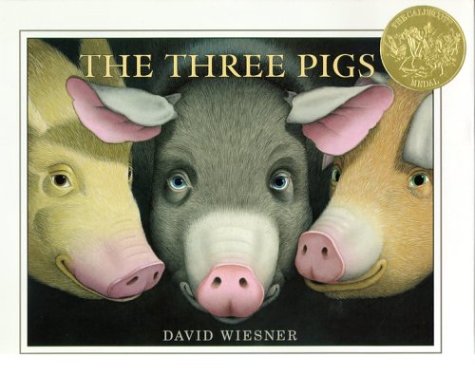
The Three Pigs


https://d.gr-assets.com/books/1172092242l/138069.jpg


Bibliography

Wiesner, David.  The Three Pigs.  New York: Clarion Books, 2001.  0329279815

Summary

What starts out as a traditional telling of The Three Little Pigs quickly takes an unexpected turn when the wolf unknowingly blows the first little pig completely out of the story. The pig takes full advantage of this situation and quickly finds his brothers, bringing them to safety and leaving the wolf in the story frames, hungry and confused.  The pigs find that they are not limited to their own story and venture through a number of different tales, collecting friends along the way.

Analysis

The Three Pigs takes fractured fairy tales to a whole new level.  Not just changing the viewpoint of the narrator or putting a cultural spin on the story, this book challenges readers to think outside the box, literally and figuratively.  Playing on his strengths as an illustrator, Wiesner seamlessly blends small amounts of dialog with stunning illustrations.  The pictures truly do steal the show and are capable of telling the story in such a way that the dialog seems superfluous. 

Young and old alike are able to enjoy this story.  Younger readers enjoy the adventures of the pigs; making and flying on paper airplanes, befriending a dragon and running across familiar faces, such as the cat from Hey Diddle Diddle.  Older readers enjoy seeing the pigs transition from looking realistic to cartoonish as they wander through the pages, finding illustrations from other Wiesner books, and imagining the pigs tumbling through the world Wiesner has created using story book pages. 

When reading this book aloud to a second grade class, they weren’t able to stay seated or simply listen.  “Look at the pigs, they’re changing!” they would shout out as the pigs moved from story to story.  The pages where the pigs were flying on the airplane were met with many ooohs and ahhhhs.  When one of the pigs appeared to look out from the book and stated “I think…someone’s out there,” he was met with a chorus of hellos and waves.  They stated this was now one of their favorite books. 

Awards and Reviews

*Caldecott Medal, 2001

“David Wiesner’s postmodern interpretation of this tale plays imaginatively with traditional picture book and story conventions and with readers’ expectations of both. (Though with Wiesner, we should know by now to expect the unexpected.) Astute readers will notice the difference between the cover’s realistic gouache portrait of the three pigs (who stare directly out at the viewer with sentient expressions) and the simple outlined watercolor artwork on the title page. In fact, the style of the illustrations and the way the characters are rendered shifts back and forth a few times before the book is done, as Wiesner explores the possibility of different realities within a book’s pages. The text, set in a respectable serif typeface, begins by following the familiar pattern—pigs build houses, wolf huffs and puffs, wolf eats two pigs, etc. But while the text natters on obliviously, the pigs actually step (or are huffed and puffed) out of the muted-color panel illustrations without being eaten…Wiesner may not be the first to thumb his nose at picture-book design rules and storytelling techniques, but he puts his own distinct print on this ambitious endeavor. There are lots of teaching opportunities to be mined here—or you can just dig into the creative possibilities of unconventionality.” –K.F., The Horn Book

“Satisfying both as a story and as an exploration of the nature of story, The Three Pigs takes visual narrative to a new level. Dialogue balloons, text excerpts, and a wide variety of illustration styles guide the reader through a dazzling fantasy universe to the surprising and happy ending.
Fans of Tuesday's Frog's and Sector 7's clouds will be captivated by old friends the Three Pigs of nursery fame and their companions in a new guise.” -Scholastic

Connections

Building a background from the few pages from the dragon’s story seen in The Three Pigs, students will write a continuation telling how the story would have gone, had the pigs not stolen the dragon away.

Wiesner's Caldecott acceptance speech.

Students could write a letter asking the pigs to save a character from another story and justifying why the character should be saved. 

In The Three Pigs, the pigs made friends with the other characters they met.  Write the names of other folktale characters on slips of paper and put them into a basket.  After students draw two names, they will write a story or comic showing what happens when the characters met after being pulled out of their stories.   

Sunday, February 8, 2015

How Chipmunk Got His Stripes

http://images.randomhouse.com/cover/9780142500217?alt=no_cover_penguin.jpg


Bibliography

Bruchac, Joseph and James Bruchac.  Illus. by Jose Aruego and Ariane Dewey.  How Chipmunk Got His Stripes.  New York:Puffin, 2001.  9781404671027

Summary

It is a lovely autumn day when Bear, feeling confident, is out for a walk.  As he is walking, he chants that he is the biggest, strongest and loudest of all the animals.  Knowing this to be true, he claims to be capable of doing anything.  Little Chipmunk overhears Bear’s claim and asks if Bear can keep the sun from rising.  Certain that he is powerful enough, Bear states he can and demands the sun to stay down.  What follows is a lesson in humility for both big and small creatures.

Analysis

People have always attempted to make sense of the world.  With simple characters, a universal setting and repeating phrases, it is easy to see how this folktale was passed down through generations of Native Americans up and down the eastern coastline.  The lessons it teaches are straightforward and show the cultural values of the tribes.  Bear’s vanity, arrogance, and ultimate downfall as well as chipmunk’s lack of empathy show the importance of humility and respect to the Native people. 

The illustrations are simple, allowing the personality of the characters to shine through.  By focusing on the animals, their size and emotions are clearly transmitted.  Young readers especially will gain more meaning from the menacing face of Bear and the teasing expressions of Chipmunk then they would from the text alone.  They will be able to sympathize with bear when the sun rises as well as feel chipmunk’s fear when trying to escape from the gigantic predator.

Awards and Reviews

Bear struts through the forest, bragging as he goes: "I am Bear. I am the biggest of all the animals. Yes, I am!-I can do anything. Yes, I can!" Little Brown Squirrel elects to challenge him: "Can you tell the sun not to rise tomorrow morning?" Bear accepts the challenge. As the sun sets, he issues his command and the two settle down to see what morning will bring. As the night progresses, the braggart continues to boast, and Squirrel cannot resist teasing. When the sun predictably rises in the morning, Bear is disgruntled and angry, and his taunter foolishly continues to tease. When Bear threatens to eat the little creature, Squirrel makes a desperate dash for his burrow. He is able to escape, but not before Bear has raked his back with his sharp claws. Although the scratches heal, they leave Squirrel with long, pale stripes on his back. He is now Chipmunk, the Striped One. In their introductory authors' notes, the Bruchacs indicate that the story is an amalgam of tales they have heard from Cherokee, Abenaki, and Mohawk sources, and has further been fleshed out through their own telling over the years. The result is polished, cohesive, and energetic. While the story begs to be told, Aruego and Dewey's vibrantly hued trademark watercolors add significantly to the humor. A priority purchase for most collections.  -Grace Oliff, School Library Journal


In Bruchac and his son's (When the Chenoo Howls) serviceable retelling of a Native American pourquoi tale, Brown Squirrel challenges prideful Bear to keep the sun from rising. When the sun does rise, and Brown Squirrel teases Bear, Bear threatens to eat Brown Squirrel, and his claw marks transform the fellow into Chipmunk. Though the prose occasionally falters (e.g., "Everyone was happy except for one animal. That animal was Bear" or the advice of Brown Squirrel's grandmother, "It is good to be right about something. But when someone else is wrong, it is not a good idea to tease him"), the dialogue is effective and invites audience participation especially the repeated phrases with sound effects, as when the quarrelsome pair sit side by side all night chanting: "The sun will not come up, hummph!" and "The sun is going to rise, oooh!" Aruego and Dewey (Antarctica Antics) create lush landscapes, but Bear and Brown Squirrel are uncharacteristically bland, often featuring the same facial expressions repeatedly.  –Publishers Weekly Reviews

Connections

To highlight similar values, students could compare Hare from The Tortoise and the Hare to Bear.  A class discussion could highlight how the stories are the same and how they are different.  We know that the stories originated in different parts of the world.  What do you think is similar about the places and people where they come from?  What do you think might be different about these cultures?  Students could then write a letter to either character explaining how they should have behaved.

An author study could be done focusing on Joseph Bruchac.  Before researching Bruchac, a number of his books such as Racoon’s Last Race, Thirteen Moons on Turtle’s Back, and The First Strawberries, could be read and students could make inferences about Bruchac’s background and what he believes is important. 

Thursday, January 29, 2015

Visiting Langston

http://ecx.images-amazon.com/images/I/
51JE68SJSRL._SX258_BO1,204,203,200_.jpg


Bibliography

Perdomo, Willie.  Visiting Langston.  Ill. By Bryan Collier.  New York: Henry Holt and Company, 2002.  ISBN 0805067442

Summary

A young girl visits the historical home of Langston Hughes with her father.  While visiting, the girl tells of Hughes’s life, work and interests while connecting her life to the famous author.

Analysis

There are many things to love about Perdomo’s first children’s book.  The narrator, a young girl from Harlem, is bright faced and confident.  Her words and the illustrations make it easy to identify her as a sweet and likeable child.  Children can easily understand and relate to her as she voices her excitement about a special trip with her father and wearing her favorite pink shirt.  It is easy to hear her voice throughout the pages, being somewhat scattered and jumping from Langston to herself, just as a young girl would do.

The illustrations are true works of art.  Collier pieced together mixed media, combining beautiful watercolor portraits with masterfully crafted collages.  The images welcome the reader to look for all the small details, relishing in the rich textures and connecting with the lifelike characters depicted.  They also provide much needed visual support for the simply versed poem.

I personally found the text a bit difficult to read.  There were awkward turning points, places where the rhythm of the verse was interrupted and broken in an odd and unexpected manner.  It appeared that they page breaks were designed to allow the illustrations to support the text, however the text would have been stronger had stanzas been kept together. 

I also felt the content jumped around a bit too much, telling about Hughes then jumping to the young narrator’s poetry and life.  I wanted to know more about the man who had captured her attention and heart.  Perhaps this was Perdomo’s hope, that the reader would be intrigued and seek out more information on this influential writer. 

Awards and Reviews

*Coretta Scott King Honor

“A rhythmic poem in praise of Langston Hughes and the writer's craft. The poem is presented by a young girl who is off to visit Hughes's Harlem home with her father. It begins, "Today I'm going to wear/My favorite pink blouse/I'm going with my daddy/To visit Langston's house." Readers quickly learn that, like Hughes, the girl is a writer and resident of Harlem. Powerful in its simplicity, the text explores the child's special connection to the famous man. "He can tell you why my/Dreams run wild/Why Daddy says I'm like/Langston's genius child." Text and illustrations complement one another perfectly as the pages of the book come to life with energetic purpose and delight. Done with a mixture of collage and watercolor with dramatic results, Collier's artwork uses muted shades of green, purple, and brown and yet shines with brilliant bits of patterns and textures. While this is obviously an urban landscape, the girl's enthusiasm and talent have universal appeal. Be sure to use this impressive collaboration to introduce young readers to the life and work of the poet (a brief author's note with some dates and titles is included) but be sure it reaches young writers as well.” -Alicia Eames, New York City Public Schools (from Amazon)

Connections

The narrator speaks of herself as a poet.  Have students write a journal entry explaining if they see themselves as a poet, why or why not? 

The mixed media illustrations help bring Visiting Langston to life.  After they have revised and edited a piece of poetry, provide students with a variety of scrapbooking papers, magazines and newspapers.  Have students create a background to illustrate their poems, and then create details using paints or markers.

Have students read Uptownby Bryan Collier to discover more about this neighborhood.  Using what they learned from both texts, have the students write or draw about what they think everyday life is like for either Hughes or the narrator living in Harlem.  Discuss how life in Harlem is similar or different from life where the students live. 

Wednesday, January 28, 2015

Millions of Cats


http://upload.wikimedia.org/wikipedia/en/5/51/
Wanda_Gag_Millions_of_Cats-book_cover.jpg


Bibliography

Gag, Wanda.  Millions of Cats.  New York: Penguin Putnam, 1928.  ISBN 0329055739

Summary

The very old man and the very old woman have everything they could want, except company.  Their solution?  A soft, cuddly cat.  When the very old man sets out to find them the perfect companion, he finds not one but millions of perfect cats.  In the end, there is only room for one cat at their house, but it isn’t the one they expected.


Analysis

Nestled between books full of vibrant color, the black and white illustrations found in Millions of Cats is unexpected on modern day library shelves.  However, the colorful books of today owe much to the simple black and white illustrations that first appeared in 1928.  Gag was one of the first illustrators to utilize both sides of a spread in a single illustration, opening up the door for future authors and illustrators to create more in-depth and interesting illustrations.

At first glance this antiquated book appears to be out of date and touch with the modern reader, but after only a few pages this proves to be far from true.  The repetition and rhythm of text make the story flow easily, particularly to be read aloud.  The inclusion of the ever so allusive amounts of “millions and billions and trillions” grabs young readers’ attention and draws them into the story.

The simple story of a man and woman who would like more company rings true universally while the silly account of taking home millions of cats is unexpected and adorable.  It is easy for the reader to understand and relate to the problems the old man experiences while dealing with this number of felines.  The end of the story takes a surprisingly dark turn when the cats devour each other in a brutal argument over who is cutest, leaving the old man and old woman with only one cat to take care of.  The last kitten, who survived because she never claimed to be cute and was therefore ignored by the other cats, may be a lesson in modesty however a less cannibalistic lesson would be more appropriate for children.

Awards and Reviews

*Newberry Honor (1929)
*SLJ Top 100 Picture Books (2009, 2012)

“More nostalgia. This one, I remember reading to myself when I was very small when we would go to my great-grandmother’s house. She had some old books in her bookcase, and I know I read this one more than once. Since then, I read it to my own sons, and I still love using it in story time. That refrain is unforgettable, and I love getting kids to chant along with me, “Hundreds of cats, thousands of cats, millions and billions and trillions of cats!” – Sondra Eklund


Connections

Have students compare and contrast Millions of Cats to One Potato, Two Potato by Cynthia DeFelice. They could compare characters or journal about which couple was more morally sound.

The Caldecott Award was established ten years after the publication of Millions of Cats.  As a writing prompt, have students justify if the illustrations would have warranted receiving this award, had it been available. 

The repetition and chorus of the book is strong.  Using Millions of Cats as a mentor text, have students write a short story with a chorus or repetition.

Locomotive


http://brianfloca.com/Images/Locomotive.jpg


Bibliography

Floca, Brian.  Locomotive.  New York: Athenum Books, 2013.  ISBN 9781416994152

Summary

Set in the early days of the American Trans-Continental railway’s birth, Locomotive follows a small family as they travel from Omaha, Nebraska to the California coast.  As they travel across the wide prairie, up, down and through steep mountain passages, the reader uncovers the inner and outer workings of the majestic locomotive the family rides upon.  Locomotive is a beautiful glimpse into the history of the American railroad.

Analysis

Without moving from his seat, the reader is taken on a steam engine journey through Floca’s detailed illustrations and engaging word choice.  The illustrations move beyond the pictures and into the words themselves, with decorative and distinct text that push the reader to feel the “CHUG-CHUG” of the train’s movement and to hear the “HUFFS and HISSES” of the engine.  The reader connects to the traveling children and feels their adventure and excitement as they move across the nation.  At the same time, the intricate workings of the train and the railway system are examined and explained without feeling like a manual or history book.

Each page presents an entire story in and of itself that deserves to be admired and examined.  The illustrations change in size and format, sometimes taking up a double page spread for a single, detailed image while other pages have multiple illustrations, each showing a unique place, feeling or part of the locomotive.  The reader could easily take multiple passes through the book and continue to find new details that would further inform about the locomotives journey.  The youngest readers would enjoy reading the illustrations, as they tell a story by themselves.

For those who want to learn more about the train, Floca’s free verse is the perfect campaign to the amazing illustrations.  His words flow through the book and around the pictures, pulling the reader to the next page while creating even more vivid image of the journey.  Unobtrusive captions inform of the location of many pictures, allowing a mental map to be made.  Together, Floca’s words and images allow this grand historical achievement to come to life for 21st century readers.

Awards and Reviews

*Caldecott Medal 2013
*Robert F. Sibert Honor Book
*New York Times Best Illustrated Books of the Year
*Wall Street Journal Top 10 Children’s Books of 2013

“Older children will appreciate the wealth of detail and history, while younger ones will be entranced by the appropriately chugga-chugga rhythm of Floca’s free verse and his abundant use of sound effects (playfully emphasized with well-muscled, 19th-century-style typefaces)…. He’s a brilliant, exacting draftsman; he also knows how to give his pictures a cinematic energy, especially in the way he “cuts” from page to page. A spread showing the train crossing a rickety wooden bridge uses a funny visual trick to jolt your eyeballs along with the passengers. Flipping through this book made me smile with pleasure before I even read it.” –New York Times

“Brian Floca weaves a poetic text and dramatic illustrations into an appealing narrative, providing young readers with both factual information about early train travel and a visceral sense of what it must have been like to climb aboard an iron horse in 1869…. Carefully varied perspectives — from spectacular close-ups of wheels meeting tracks to lonely long shots of a toy-size string of cars lost in a vast sea of grass — as well as wildly varying fonts give readers a sense of the thump-and-bump, start-and-stop, rush-and-wait of this week-long excursion.” –The Washington Post

Connections

To connect to social studies, students could make a map showing the path of the trans-continental railway and marking significant points from the book.

Students could examine and compare the historical role of trains in America, using additional texts such as Train to Somewhere or The Orphan Rider.

To connect today with the past, students could read articles about modern day trains, then compare and contrast with the steam locomotive.  Alternatively, they could research the history of the development of rail and make a timeline that tells major milestones.