Tuesday, June 14, 2016

Z for Zachariah

https://images-na.ssl-images-amazon.com/images/I/51rqbjzojiL._SX356_BO1,204,203,200_.jpg


Bibliographic data: 

O'Brien, R. C. (2002). Z for zachariah. New York: Simon Pulse.

Summary  

After a weeklong war, the United States has been ravaged by a nuclear holocaustic.  Everything and everyone is dead, with the exception of sixteen-year-old Ann Burden.  Thanks to an unusual weather pattern, the valley she calls home is unaffected by the radioactive fall out.  She believes she is the last person alive…until Mr. Loomis appears in a radioactive safe suit.

Analysis  

Written as if reading Ann’s diary, Z for Zachariah is an engaging page-turner.  Unlike many dystopian books, Ann does not focus on survival.  Her agricultural upbringing has taught her the skills needed to meet her physical needs.  The fact that she may be the only person left alive in the country doesn’t seem to upset her much, she is too busy working to survive.  The conflict in the story is the relationship between Ann and Mr. Loomis.

Ann’s behavior in the novel is mystifying.  To start, she is strong and independent.  She runs her family’s farm on her own, keeping herself not only alive but also thriving, for over a year.  Yet, when Mr. Loomis appears Ann seems incapable of standing up for herself.  Mr. Loomis begins to dictate how the farm will be run, at times forcefully preventing Ann from completing tasks.  Ann rarely questions Mr. Loomis and continues to care for him, determined to keep him alive.  Even after Mr. Loomis attempts to physically harm Ann and she decides to move into the hills to be away from him, she continues to ensure that he has adequate food and is well taken care of. 

This inability to standup for herself goes against everything that society is working to teach girls.  While on her own, Ann is strong but she immediately bows when a man appears.  This is frustrating to see, however it could be an extremely beneficial novel for young girls who are in similar situations.  Ann is able to justify her loyalties to Mr. Loomis, she justifies his behaviors even when, to the reader, his actions are irrepressible.   Young girls who are developing their inner strength may be able to see themselves or their situations in Ann. 

Z for Zachariah would be an interesting book for young adults who enjoy stories about dystopian futures.  It is old enough that it provides a different prospective, rather than zombies or authoritarian governments, it is a nuclear holocaust; rather than fighting to survive, it focuses on the interactions and mindset of the characters.  It would be an interesting choice to compare against popular novels of today, such as the Hunger Games or The Maze Runner. 

Activity  

In a world without budget constraints, it would be amazing to present the readers with an opportunity to experience some of the farm work that is discussed in the novel, particularly for urban teens.  This could be done through a series of guest speakers that can discuss and educate on crops and animals, a small garden could be setup at outside the library for students to tend to or a trip could be arranged to visit a working farm.  Readers could engage in the activities that Ann does, such as caring for chickens, milking cows and farming by hand. 

 Related Resources  

The video “Nuclear War’s Worst-case scenario” could be used to engage students before reading.  The book begins a year after nuclear weapons were dropped.  In this video, clips from a number of Cold War and films about nuclear weapons have been put together to replicate what would happen during a nuclear attack.  The video would set the scene for what the world around Ann would be like.
Cdcollura. (2012). Nuclear war's worst-case scenario (nobody wins). Retrieved from https://www.youtube.com/watch?v=BRWzNIaVyBs


Ann survives the destruction around her by farming.  For many teens in America, farming is completely foreign.  The Farm School is exactly what it sounds like, a school where the subject is farming.  They offer a yearlong course for adults, 3-day field trips for students and summer camps for kids and teens.  For a large undertaking or for students who are particularly interested in Ann’s way of life, this could be a resource to gain an understanding of this skill set.  Additionally, they have a resource section of their website that students could utilize to learn more about agriculturally based life.
The farm school. Retrieved from http://farmschool.org/


Published Review

“Z is for Zachariah, the last name in fifteen-year-old Ann Burden's Bible school alphabet book; it's also for zero population after nuclear bombs and nerve gas seem to have destroyed everyone in the world except Ann in her Amish country valley (her family left it and seem singularly unregretted but then Ann is one of those unthinking practical types) who is making it alone with her brother's dog Faro, with their cow, chickens, the diminishing supplies from the store and her garden. Until a stranger comes over the hill in his plastic safe-suit -- he'd killed to get it; he has a bout of radiation sickness and almost dies but Ann brings him back to health only to face a lethal gratitude on his part. Mr. O'Brien wrote two juveniles as well as another genocidal thriller, A Report from Group 17. This is a little of each for both audiences and you'll find Ann's level resourcefulness as insulating as that safe-suit. So, less convincingly so, is her abz naivete in a day and age which has just come to an end.”

O'Brien, Robert C. 1975. Z for Zachariah. n.p.: Atheneum, 1975. Book Index with Reviews, EBSCOhost (accessed June 11, 2016).

Friday, May 1, 2015

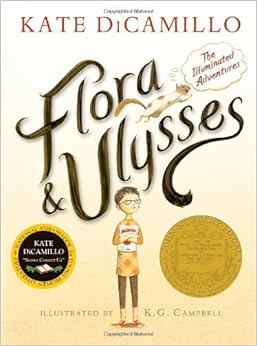
Flora & Ulysses: The Illuminated Adventures

http://ecx.images-amazon.com/images/I
/51whi5u8GDL._SY344_BO1,204,203,200_.jpg


Bibliography

DiCamillo, Kate.  Illus. by K.G. Campbell.  Flora & Ulysses: The Illuminated Adventures.  Somerville: Candlewick, 2013.  978-0-7636-6040-6


Summary

Comic-loving Flora is a self-declared cynic, but that doesn’t keep her from caring.  When her neighbor’s new vacuum accidentally sucks up a squirrel, Flora is there in flash to assist the poor creature.  This begins an unbelievable and amazing chain of events that will strengthen Flora’s family ties and intertwine her life with Ulysses, a poetry-writing Super Squirrel.

Analysis

Flora is a girl that the nerd in everyone will love.  The voice DiCamillo has created for her is strong and confident while she questions and works out the world around her.  The influence of her favorite comic book character gives her a unique way of seeing the world and quirky catch phrases, such as “Holy bagumba,” make Flora truly come to life.

All the characters in the book are overly dramatic and slightly odd, but these factors serve to make them more enjoyable and somehow more relatable.  In a story that teaches about love and believing in something, the character flaws of parents and neighbors serve as a lesson in understanding and compassion.  I also suspect that to young children of divorced parents, the absurdities I see as an adult may not seem quite as ridiculous. 

Every time Ulysses, the superhero squirrel, does something super, it is presented as a comic.  This adds to the story by further bringing Flora’s love of comics into the book.  It also brings Ulysses more to life.  The best part though, as a teacher, is that it bridges the gap between chapter books, picture books and comics.  With every passing year, more and more students are reluctant to read books that are predominantly made of words.  Flora and Ulysses helps these students to make the jump.

Awards and Reviews

*2014 Newbery Medal
*National Book Award Longlist

“When a neighbor accidentally vacuums a squirrel into a Ulysses 2000X vacuum cleaner, Flora resuscitates him into a “changed squirrel,” able to lift the 2000X with a single paw. Immediately assuming he’s a superhero, Flora names the squirrel “Ulysses” and believes together they will “[shed] light into the darkest corners of the universe.” Able to understand Flora, type, compose poetry and fly, the transformed Ulysses indeed exhibits superpowers, but he confronts his “arch-nemesis" when Flora’s mother tries to terminate him, triggering a chain of events where Ulysses becomes a real superhero. The very witty text and droll, comic-book–style black-and-white illustrations perfectly relay the all-too-hilarious adventures of Flora, Ulysses and a cast of eccentric characters who learn to believe in the impossible and have “capacious” hearts.
Original, touching and oh-so-funny tale starring an endearingly implausible superhero and a not-so-cynical girl.” –Kirkus

“Since Flora’s father and mother have split up, Flora has become a confirmed and defiant cynic. Yet it is hard to remain a cynic while one’s heart is opening to a squirrel who can type (“Squirtl. I am . . . born anew”), who can fly, and who adores Flora. Newbery winner DiCamillo is a master storyteller, and not just because she creates characters who dance off the pages and plots, whether epic or small, that never fail to engage and delight readers. Her biggest strength is exposing the truths that open and heal the human heart. She believes in possibilities and forgiveness and teaches her audience that the salt of life can be cut with the right measure of love. “ -Booklist


Connections

An interview with DiCamillo

Flora uses amazing vocabulary throughout the book.  Provide each student in class with an impressive word.  Students then will look up their word.  When they have an understanding of its meaning, they will create a one page comic to illustrate it.  Combine these comics into a Class Comic Dictionary.

The official book trailer

While they came to a reconciliation at the end of the book, throughout the book Flora and her mother were at odds over just about everything.  Choose one thing they disagreed about.  Write a letter from Flora to her mother (or vice versa) explaining the problem and providing a number of possible solutions.  Be sure to justify and explain Flora’s viewpoint and show kindness and respect.

Resources from the author


Flora shows great compassion for others throughout the book.  Research different local causes, such as animal shelters, soup kitchens or food banks.  Arrange to volunteer for the organization.  Can you turn your experience into a superhero comic?

The Most Excellent and Lamentable Tragedy of Romeo & Juliet: a play by William Shakespeare

http://ecx.images-amazon.com/images/I
/51yTOeZfsZL._SY344_BO1,204,203,200_.jpg


Bibliography

Hinds, Gareth. The Most Excellent and Lamentable Tragedy of Romeo & Juliet: a play by William Shakespeare.  Somerville: Candlewick Press, 2013.  978-0-7636-5948-6

Summary

A classic tale of forbidden love is given new life in the format of a graphic novel.  Two families, the Montagues and Capulets, are at eternal odds.  Their dislike for each other often turns to violence.  Despite this feud, young Romeo Montague and Juliet Capulet find each other and immediately fall hopelessly in love.  Tragedy is on the horizon for all, as young love deepens and the hatred between families grows.

Analysis

Beautiful illustrations bring Shakespeare’s original work to life in this modern adaptation.  Vivid watercolors capture the elegance and graces of the story, while Batman-style onomatopoeias bring action and movement to the words.  The modern format opens the work to a new generation of readers who may otherwise be put off to the antiquated style of writing.

Unfortunately, the comic style often hinders the original format.  Due to the small space for speech bubbles, the work is abridged and the iambic pentameter often destroyed by misplaced line breaks.  While there are sections of the book where the original lines have been preserved, the areas where design dominates verse are hard to read and lack the original power of Shakespeare’s writing. 

While Hinds’s work opens the door, those who are reluctant will likely still require assistance and care to learn to enjoy Shakespeare.  I am personally not a fan of reading Shakespeare’s works.  I found the graphic novel to be more pleasant than simply reading, but would not choose it over seeing the works acted out. 

Awards and Reviews

*YALSA 2014 Great Graphic Novels for Teens nomination
*Kirkus Best Teens Books 2013 selection

“Hinds as director, set designer and writer has expertly abridged the original text while embellishing it with modern sensibilities. His edition retains the flavor and poetry of the 1597 play and its memorable and oft-quoted dialogue. It is in the watercolor and digitally illustrated panels that he truly presents a stunning visual reading. Juliet and the Capulets are from India. Romeo and the Montagues are from Africa. Thus, the political rivalries of Verona become contemporary and more meaningful to 21st-century readers. The Capulets are dressed in reds and the Montagues in blue—all against the finely rendered lines of Verona’s buildings and Friar Laurence’s monastery. Beautiful shades of blue infuse the night sky as the two lovers swear their eternal devotion. The panels vary in size to control the pace of the plot. Sword fights pulse with energy and occasional karate thrusts for added drama. The most moving image—a double-page spread without words—is depicted from above in shades of gold and brown stained red with blood as Romeo and Juliet lie dead and immortalized in each other’s arms. As thrilling and riveting as any staging.” –Kirkus

“Cleaving to Shakespeare’s words and his dramatic arc, Hinds creates another splendid graphic novel, tracing each scene in taut, coherent, and expertly deployed dialogue. Hinds’s characters, in period array modified by a few more contemporary touches, are poignantly specific yet as universal as this tragic tale of young love demands. ... . Expertly pacing the drama with varied frames, often with sharp, action-propelling angles, Hinds explicates and amplifies Shakespeare’s story on every page, including wordless fight scenes that highlight pivotal details. ... From swirling action to subtly delineated emotion, he delivers the play’s essence and beauty, its glorious language, furious conflict, yearning love, and wrenching tragedy. This is not only a wonderfully accessible introduction to a full text or (better yet) theatrical production; it’s a visual delight for anyone.” –The Horn Book

Connections

Read, watch and act out Romeo and Juliet.  Write a comparison about how the different mediums affect your understanding and reaction to the play. 

Gareth Hinds’s Website

Hinds's Sketch Blog

Hinds has turned a number of other Shakespeare works into graphic novels, such as MacBeth and The Merchant of Venice.  Choose one of these titles to read.  Create separate Venn Diagrams comparing the illustrations, emotion, and main characters from the books.

A presentation by Hinds

Q&A with Hinds


Hinds took an old, famous story and made it his own.  Choose an old story that you love and give it new life.  Reinvigorate it any way you would like, such as making a graphic novel, filming a movie or creating a stop-action film.

The Book Thief

http://upload.wikimedia.org/wikipedia/en/8/8f/
The_Book_Thief_by_Markus_Zusak_book_cover.jpg


Bibliography

Zusak, Markus.  The Book Thief.  New York: Knopf, 2005.  978-0-375-84220-7

Summary

Liesel was not born a thief, it is a habit she has decided to cultivate and develop.  Stealing books gives her something she can control in an otherwise uncontrollable world.  Given up by her mother, watching her brother die, and living in a nation being torn apart of the atrocities of Hitler and World War Two, there is little else in her life she has power over.  While stealing away her books, Liesel learns to hope from those around her, discovers a new family and learns compassion in ways she never could imagine.

Analysis

While stories of the Holocaust and Hitler are popular these days, The Book Thief stands out.  To begin, it does not tell the story of concentration camps or Jews, but rather the life of a young, average, German girl.  Rather than focusing on the atrocities experienced by the persecuted, Zusak illustrates the everyday struggles of the poor and under-educated; a population easily over looked by history due to their lack of involvement or direct suffering during the war.  To add to this unique perspective, The Book Thief is voiced by a narrator who, while a major player in World War Two is rarely heard directly from; that of Death himself.

It seems only appropriate that Death would narrate a novel that is set in Germany in the midst of World War Two.  The voice that Zusak has created for him is somehow equally unexpected and absolutely perfect.  Death is cool and causal about the events of the human world around him, painting a picture of the world Liesel lives in without becoming overly connected to the humans he passes and carries.  At the same time, he is able to express all the anguish, fear and hope those who live with Liesel on Himmel Street experience, giving insights that allow the reader to connect with every major character in the book.

Of all the characters, Liesel and her Papa, Hans, are the most likeable.  Every action they take shows the depth of their compassion and the quality of their characters.  While the rest of Germany appears to have aligned their beliefs with Hitler, Hans does what is right and not popular, despite the repercussions he faces.  Liesel, in her own, more selfish way, also does what is right; rather than live illiterate and uneducated, she searches for opportunities to steal knowledge and learning.  Together, they work to make the best of the bad situation they have been given, eternally optimists.

Awards and Reviews

*SLJ Best Book of the Year
*Michael L. Printz Honor Book
*National Jewish Book Award for Children’s and Young Adult Literature
*Daniel Elliott Peace Award

The Book Thie’ is perched on the cusp between grown-up and young-adult fiction, and it is loaded with librarian appeal. It deplores human misery. It celebrates the power of language. It may encourage adolescents to read. It has an element of the fanciful. And it's a book that bestows a self-congratulatory glow upon anyone willing to grapple with it….
To be sure, The Book Thief attempts and achieves great final moments of tear-jerking sentiment. And Liesel is a fine heroine, a memorably strong and dauntless girl. But for every startlingly rebellious episode — Rudy's Führer-baiting impersonation of the black American athlete Jesse Owens, the building of an indoor snowman for a Jew in hiding, the creation of books and drawings that frame Liesel and Max's experiences as life-affirming fairy tales — there are moments that are slack.
The Book Thief will be appreciated for Mr. Zusak's audacity, also on display in his earlier I Am the Messenger. It will be widely read and admired because it tells a story in which books become treasures. And because there's no arguing with a sentiment like that.”  -New York Times

“When Death tells a story, you pay attention. Liesel Meminger is a young girl growing up outside of Munich in Nazi Germany, and Death tells her story as “an attempt—a flying jump of an attempt—to prove to me that you, and your human existence, are worth it.” When her foster father helps her learn to read and she discovers the power of words, Liesel begins stealing books from Nazi book burnings and the mayor’s wife’s library. As she becomes a better reader, she becomes a writer, writing a book about her life in such a miserable time. Liesel’s experiences move Death to say, “I am haunted by humans.” How could the human race be “so ugly and so glorious” at the same time? This big, expansive novel is a leisurely working out of fate, of seemingly chance encounters and events that ultimately touch, like dominoes as they collide. The writing is elegant, philosophical and moving. Even at its length, it’s a work to read slowly and savor. Beautiful and important.” –Kirkus

Connections

Read Night by ElieWiesel or Maus by Art Spiegelman.  Using what you learned about Max from the The Book Thief and the image of life in the concentration camps created by the other book, create a journal or narrative of Max’s life after the Germans captured him. 

Liesel is around the same age as Dewey from The Green Glass Sea and alive during the same time period, however their life experiences are very different.  Write a script of a conversation between the two girls about their experiences during World War Two.

Watch the movie version of The Book Thief.  Compare and contrast the two stories. Which version do you like more?  Why?

Markus Zusak writes about his book being made into a movie.


An interview with Zusak

Zusak’s Twitter

Friday, April 10, 2015

Rodzina

http://ecx.images-amazon.com/images
/I/51KY4CP0D9L._SY344_BO1,204,203,200_.jpg


Bibliography

Cushman, Karen.  Rodzina.  New York: Clarion Books, 2003.  0-618-133-518

Summary

By the age of twelve, Rodzina Clara Jadwiga Anastazya Brodski had more life experience than most people three times her age.  After immigrating with her family to Chicago, she lived a happy life for a number of years being cared for by her mother, sharing laughter with her father and watching over her two younger brothers.  In her twelfth year, her happiness quickly disappeared as her entire family passed away.  Alone and penniless, she lived on the streets before being sent west on an orphan train to find a new family.  But who would want a potato-nosed, not-so-pretty girl? 

Analysis

The idea of becoming an orphan is intriguing to children.  It is a tragedy they can easily imagine, they are able to immediately understand the effect the loss of their parents would have on their life.  This relatable tragedy draws children into Rodzina’s story.  The intrigue of the historical facts keeps them engaged and interested in her world.

Rodzina is amazing similar to children today.  Her hopes, fears and desires mirror those of any child; she wants a family who cares for her, who will love her and who will take care of her no matter what.  These universal and timeless themes keep the reader connected to Rodzina when her experiences venture far from modern day expectations and standards. 

Taking place aboard the trans-continental railway, the reader is reminded of the setting not only with the descriptions of the passing landscape but also by the title of each chapter, which tells where the train has stopped.  At many of these stops, Rodzina reads the advertisements that are posted, giving the reader an idea of what was important to people of the time and creating a frame of reference for the decisions the characters make. 

Rodzina’s story, while fictional, is historically accurate and based on research.  For students who wish to know more, a list of books for further reading is at the back of the book following Cushman’s notes telling about the orphan trains and the orphan train experience.

Awards and Reviews

*Parents’ Choice Gold Award
*Booklist Editor’s Choice
*Booklinks Lasting Connections Selection

“Rodzina is prickly, stubborn, and heart-sore but she's also honest, likable and smart...Enough unpredictability to nicely unsettle expectations." –The Horn Book

“A natural for American history or social studies classes...especially interesting as a women's history title...a great story." –Booklist

“Engaging characters, a vivid setting, and a prickly but endearing heroine... first-person narrative captures... personality and spirit...poignancy, humor.” –School Library Journal

Connections

Create a map of the trans-continental railway.  Add markers showing key points in Rodzina’s journey west.

Research orphan trains.  Were the trains a good or bad idea?  Justify your opinion with facts from your research.

20 Facts about Karen Cushman

Interview with Cushman


Choose one of the other orphans from the story.  Write their story.  Include details about their life in Chicago, their thoughts about being on the orphan train and their hopes for what they will find in a new family.  Be sure to align your ideas with the character Cushman created.

Wednesday, April 8, 2015

The Green Glass Sea

http://photo.goodreads.com/books/1298452600l/149132.jpg


Bibliography

Klages, Ellen.  Read by Julie Dretzin.  The Green Glass Sea [CD].  New York: Penguin Putnam/Recorded Books.  2006.  9781428146396

Summary

In the midst of World War Two, life is difficult for all Americans.  This is particularly true for eleven-year-old Dewey Kerrigan.  After being abandoned by her mother as a toddler, Dewey has spent many years in the care of her grandmother while her father, a well-known and respected mathematician, has moved around the country teaching and working for the government.  After her grandmother suffers a stroke, Dewey is reunited with her father in Los Alamos, New Mexico where they live on a top-secret military base with scores of other mathematicians and scientists developing some type of “Gadget.”  Life on The Hill is a dream for Dewey; living with her father and being surrounded by brilliant men and women who are able to answer all her questions about math, science and machines without concerning themselves with her gender.  Her happiness on The Hill is interrupted when her father is requested to work in Washington, once again leaving her in the care of others.  This time however, it is not her grandmother but a family she hardly knows with a daughter who dislikes Dewey…and they are sharing a bedroom.

Analysis

Julie Dretzin expertly reads the seven unabridged CDs that make up this audio book.  Dretzin is a well-rehearsed and experienced performer, having acted on Broadway.  Her experience and expertise are easily heard through the multiple voices she creates, giving each character their own distinct sound.  A mental picture of Dewey is easy to create when listening to her small and uncertain voice talk about complicated mechanics and science concepts.  The confidence of a world-renowned mathematician comes through in her father’s voice, while at the same time capturing the uncertainty and stress of the project he is working so hard on.  There are no additional sound effects, beyond music to indicate the beginning and end of each CD, but the reader needs no additional noise, between Dretzin’s reading and Klages words a clear understanding and mental movie are created.

The Green Glass Sea is a perfect balance of fact and fiction.  The themes running through the book of family love, peer acceptance and following your dreams ring true in any time period while the feel of the fifties is captured through discussions of war, popular activities like “grabbing a Coke” and use of phrases such as “spiffy.”  The top secret nature of “The Project” keeps technical science talk to a minimum, however all the hints and overheard conversations are accurate.

The story itself is engaging and compelling, both to the intended young adult audience as well as to older readers.  Younger readers will easily connect with Dewey, who is confident in her ability and preferences, but lacks social graces with her peers.  Many young readers will be able to relate to her, sympathizing with her pain about being teased and understanding her interest in things her peers just don’t appreciate.  The mystery project that all the scientists and mathematicians are working on will keep kids wondering, while the code words used to describe the project will engage and entertain.  Girls, especially those interested in math and science, will find the social attitudes about women in these fields intriguing and unfair and will develop a new appreciation for how far society has come.

Older readers with a deeper understanding of World War Two will enjoy a peek into the daily lives of the civilians who worked endlessly to create the first atomic bomb.  Through the eyes of Dewey, we are able to see how life was for these brilliant minds, their motivations and hesitations about creating the most destructive force known to mankind.  The inner workings of the base and how the children of the project lived are subjects rarely touched on by historians and provide a new angle to an old subject. 

Awards and Reviews

*Scott O’Dell Award for Historical Fiction- 2007
*Judy Lopez Memorial Award for Children’s Literature – 2007
*One Book, One Nebraska for Kids – 2009

“Klages makes an impressive debut with an ambitious, meticulously researched novel set during WWII. Writing from the points of view of two displaced children, she successfully recreates life at Los Alamos Camp, where scientists and mathematicians converge with their families to construct and test the first nuclear bomb. Eleven-year-old Dewey, the daughter of a math professor, is shunned by the other girls at the camp due to her passionate interest in mechanics and her fascination with the dump, which holds all sorts of mechanisms and tools she can use for her projects. Her classmate Suze is also often snubbed and has been nicknamed "Truck" by her classmates ("'cause she's kind of big and likes to push people around," explains one boy). The two outcasts reluctantly come together when Dewey's father is called away to Washington, D.C., and Dewey temporarily moves in with Suze's family. Although the girls do not get along at first (Suze draws a chalk line in her room to separate their personal spaces), they gradually learn to rely on each other for comfort, support and companionship. Details about the era-popular music, pastimes and products-add authenticity to the story as do brief appearances of some historic figures including Robert Oppenheimer....the author provides much insight into the controversies surrounding the making of the bomb and brings to life the tensions of war experienced by adults and children alike.” –Publisher’s Weekly

“Dewey is an especially engaging character, plunging on with her mechanical projects and ignoring any questions about gender roles. Occasional shifts into first person highlight the protagonist's most emotional moments, including her journey to the site.... After the atomic bomb test succeeds, ethical concerns of both youngsters and adults intensify as the characters learn how it is ultimately used. Many readers will know as little about the true nature of the project as the girls do, so the gradual revelation of facts is especially effective, while those who already know about Los Alamos's historical significance will experience the story in a different, but equally powerful, way.” –School Library Journal

 Connections

Ellen Klages biography

The Penguin Educator’s Guide for The Green Glass Sea

Have students read WhiteSands, Red Menace, Klages continuation of the story.

Research the Manhattan Project, then look for historical facts included in the The Green Glass Sea.


Read another story of World War Two, such as Number the Stars or The Diary of Anne Frank.  Compare the lives of the girls, who were alive at the same point in history.  

Have students write a letter from Dewey to a child in Hiroshima after the bombing.  Have students reflect on how Dewey would feel about the dropping of the bomb and what she would want to convey to its' victims.

Breaking Stalin's Nose

http://d.gr-assets.com/books/1361640194l/10693803.jpg


Bibliography

Yelchin, Eugene.  Breaking Stalin’s Nose.  New York: Henry Holt and Company, 2011.  9780805092165

Summary

Sasha Zaichik is a loyal communist, dedicated to Joseph Stalin.  Sasha longs to be just like his father, an honored and awarded member of the USSR’s State Security.  Sasha has an unwavering belief in communist ideals and sees that everything around him aligns with the perfect world Stalin is working so hard to create.  He lives with forty-eight people in a communal apartment with one small kitchen and one toilet, which helps develop community and assists them in taking care of each other.  When his father comes home, the neighbors fall quiet, not due to the fear their faces show but because of respect for him as a good communist. 

In the middle of the night, State Security officers come, tear apart the room Sasha shares with his father and take his father away.  As the neighbors move into the now unoccupied room, Sasha is left reeling.  Certain that a mistake has been made, he goes through the night and the next day with as much normalcy as possible, however every passing event turns his world more upside-down.


Analysis

From the title and standard American perspective, Breaking Stalin’s Nose would appear to be a typical book opposed to the ideals of communism and the beliefs of the USSR during the early twentieth century.  These assumptions and background make the first chapter an amazing hook.  The book begins with a letter to Stalin, praising him and the state he has created.  Without a hint of sarcasm or mischief, the letter speaks of the unfortunate American children and how blessed the writer is to have been born under such a strong, wise leader.  This conflict against traditional American ideals continues throughout the book, driving the reader forward, wondering if Sasha will continue in his firm belief or if his faith in Stalin will be broken.

In his first novel, Zaichik has created an intriguing story that is supplemented by his black and white, cartoonish illustrations.  For younger readers, the illustrations will serve to assist in picturing the world described, however the story stands strong on its own.  

Awards and Reviews

*2012 Newbery

"Mr.  Yelchin has compressed into two days of events an entire epoch, giving young readers a glimpse of the precariousness of life in a capricious yet ever-watchful totalitarian state."  -Wall Street Journal

"Through Sasha's fresh and optimistic voice, Yelchin powerfully renders an atmosphere of fear that forces false confessions, even among schoolchildren, and encourage neighbors and family members to betray one another without evidence.  Readers will quickly pick up on the dichotomy between Sasha's ardent beliefs and the reality of life under Stalinism, and be glad for his ultimate disillusion, even as they worry for his future."  -Publisher's Weekly

"Yelchin's debut novel does a superb job of depicting the tyranny of the group, whether residents of a communal apartment, kids on the playground, students in the classroom or government officials.  It's the readiness of the group to create outsiders--bad ones, "unreliables,""wreckers"--by instilling fear in everyone that chills.  Not many books for such a young audience address the Stalinist era, when, between 1923 and 1953, leaving a legacy of fear for future generations."  --Kirkus Reviews


Connections

To begin reading, watch the first chapter read by “Sasha” himself.

Explore the Breaking Stalin’s Nose website. 

Research Stalin and Communism to gain a deeper understanding of Sasha's experiences.

Sasha starts the book by writing a letter to Stalin.  After having read the book, students can write another letter from Sasha to Stalin taking into account all the events from the book.  What does Sasha have to say to Stalin now?

What would a world be like living in tight quarters with people you didn't know if you could trust?  Imagine you live in a shared apartment.  Write a letter to a friend explaining the ups and downs of this living situation while trying to persuade him to live in a room of your shared apartment.

Macmillan discussion guide